Bindusara, Bindusara, the son of a great king,
Bindusara, Bindusara, the father of a greater king;
Bindusara, Bindusara, a ruler of glory and might,
Bindusara, Bindusara, preserver in his own right.
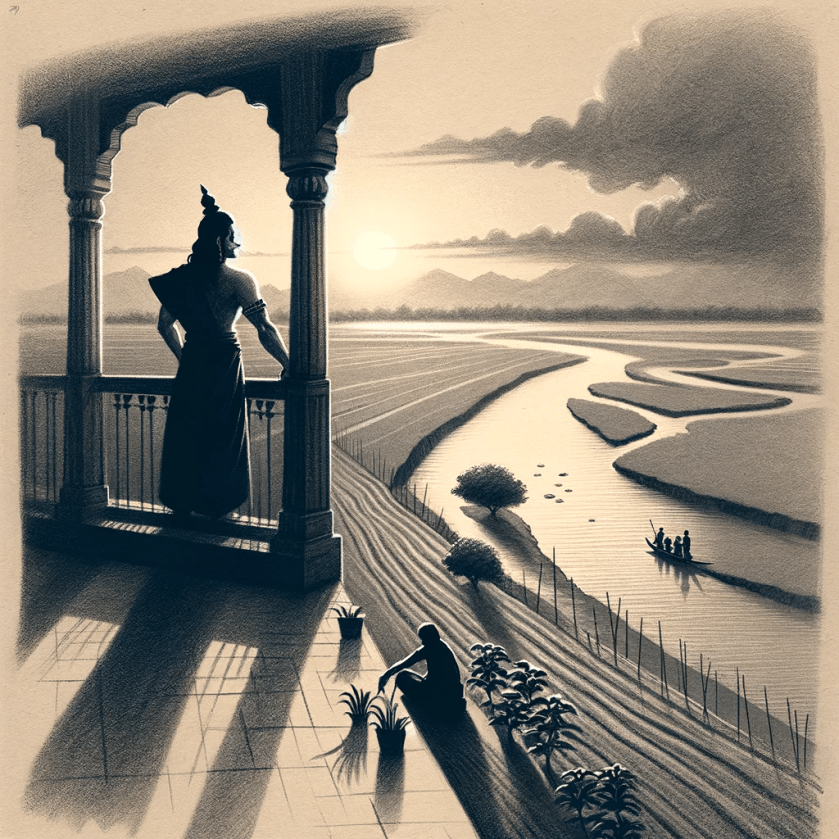
From his palace at Patliputra, Bindusara gazed at the yore. The vast river Ganga flowed at a sluggish pace. It was the lean season, so the channels were narrow, interspaced with vast sand formations. Farmers were planting vegetables taking advantage of the fertile soil. They would then sell the produce, providing nourishment to his subjects and contributing to the growth of his glorious empire.
The summers would soon peak and then it would be time for torrential downpours. This would be followed by winter and another new cycle of seasons. He would grow one year older- adding another year of glory and fame. Yet, as the sun dipped below the horizon, Bindusara felt the weight of his inheritance.
Glory and Fame ! Bindusara inherited a vast empire from his father Chandra Gupta Maurya who was the founder of the Mauryan Dynasty. Chandra Gupta Maurya had overthrown the powerful Nandas to establish his kingdom at Pataliputra. He went on to defeat Seleucus, the Greek viceroy of Alexander, and his empire soon stretched from Bengal in the east to the Hindu Kush in the north west. He was supported by Chanakya, his advisor, mentor and friend, whose statecraft ensured rule of law, diplomacy and an efficient administration. The Kingdom was prosperous and the people happy. Even in death, Chandra Gupta attained glory. Following Bradabahu, the great Jain ascetic, he converted to Jainism, went south, attaining immortality by fasting to death.
Bindusara knew that his father had worked hard to earn his stature. With no lineage like Ajatshatru or Dhana Nanda, Chandra Gupta had risen from an impoverished family, and armed with bravery, skill and intelligence, had worked his way right to the very top. Chandra Gupta Maurya was a Creator and gave his son, Bindusara, a vast empire as an inheritance to govern.
His father had etched his name into the hall of immortality, taking risks, doing things not done before and even seeking death in a most noble way. In contrast, Bindusara’s had none of those exciting chapters. Was it necessary to take the unbeaten path to enter the hallowed portals of fame? Or could he also be praised for the paths not taken, the risks not endured.
His reign had been steady and quiet, but whispers of discontent began to reach his ears. A young rebel leader, claiming descent from the Nandas, had ignited a rebellion in the west. His court urged swift and ruthless action, as his great father would have done.
Fellow kings jeered at him. They whispered around that he was nothing like his father who built the vast empire from scratch. He suspected that many of his ministers felt the same. That was one of the reasons why he relieved the old Chanakya from his responsibilities and asked him to proceed on pilgrimage. He always suspected that Chanakya did not have the same respect for him as he had for his father.
Bindusara felt guilty. Obviously he had none of the achievements of his father to gloat and no exciting stories to tell. In the streets of Patliputra, where he often went out in disguise, he heard his father’s exploits, which were now folklore. In contrast, he scarcely heard praises about himself. Once he overheard his subjects’ yearning for a ruler with the vigour and valour of his father. “Our King does not forge his own path,” one said, “he walks the road laid before him. “This is what happens when one is born in luxury, there is no zeal, no drive, no ambition,” muttered the other in agreement.
And this was the problem. Or was it? No prince would have had it better. Bindusara did not have to fight poverty, forge alliances, make promises and go for conquests to establish an empire. This was all done by his father, who went through this exhausting grind. He was born with a silver spoon in his mouth – quite literally – did he not have lick honey from one, in his “Annaprasan” ceremony.
His father was larger than life who rose like a phoenix from the ashes to accomplish great things. In contrast, he was already on a golden pedestal with rivers of aplenty flowing around. Was it his fault that he was born in royalty? Was it his fault that he had no rags to riches story to enthuse the rabble? He had the best of education, learnt how to fight and engaged in deep conversations with the wise men of his court. His administration was firm and efficient and its borders were secure. His people were happy or so he thought. And yet this rebellion?
How he wished for wise and sane counsel. The courtiers around would fawn over him, each currying for a favour – each having their own personal axes to grind. They were all “Yes men” who were like opium – giving instant gratification while befuddling his brain. He asked his friend, the Macedon king Antiochus-I for sweet wine, dried figs and a sophist. He got the excellent wine and figs but a sophist was not sent – apparently forbidden under Greek law.
He was “Bindusara” which meant “strength of a drop”, referring to the drop of poison which touched his head when he was born. He not only survived but also flourished. The Greeks called him Amitrochates – derived from his Sanskrit name “Amitraghata”, slayer of enemies. Was he expected to live and die by these epithets ? Should he not gather his army, crush the rebellion? He could do one better than his father and conquer the unconquered lands. The south lay out of his grasp as did the troublesome Kalinga due east. Should he add these to his great kingdom and etch his name alongside his father?
Or he could be the “Preserver”. Lord Vishnu and his ten avatars were as much revered as the “Creator” Lord Brahma and the “Destroyer” Lord Shiva. He could preserve what had been bestowed upon him and pass on the legacy to his heirs.
Tormented by the words on the street, the whispers in the court, the internal tumult, and driven by a desire to prove his worth, Bindusara resolved to face the rebellion with understanding. He embarked on a secretive journey to the rebellious region, dressed as a common traveller.
Along the way, Bindusara saw the plight of his people: the harsh taxes and the brutal enforcement of laws that spurred the rebellion. In a dusty tavern, he met with the rebel, a charismatic young man whose grievances echoed those of his followers. They spoke at length and spent considerable time together.
Amongst other things, some of his words struck deep. “Your subjects toil hard from morning to night for two square meals a day, ” the rebel said. “They marry and have children who carry on the same drudgery that would be repeated generation after generation. Leadership, conquests and glory are as foreign to them as the Greeks to India. Their expectations of their king are limited to remain secure and earn their living peacefully. But the wars, the taxes which they entail, the loss of life and crops, not to mention the harsh punishments, all add to their misery”. For the first time, Bindusara viewed his empire through the eyes of those it had failed.
Returning to Patliputra, Bindusara called his advisors together. “We will not crush this rebellion with force,” he declared. “We will address the root of this discontent. We will ensure fair treatment for all. We need not innovate or enforce with impunity but improve the efficiency of our administration.”
His decision shocked the court but marked the beginning of a new approach. The gentle reforms had its desired effect. Nothing spectacular. Just better implementation with an ear to the ground. The rebellion dissolved as quickly as it had formed. The kingdom was peaceful once again. He liked the term which was now associated with his rule – “enlightened despotism”.
Bindusara further proclaimed that he would not embark on any new major conquests. His father had spent much of his life conquering and building his great empire. This left him with little time for his family. He did not understand what further purpose he would gain by mounting the horse of ambition and chasing unattained glory. Bindusara resolved to devote time to his family. His family of subjects and his family at home. His success would be in balancing both…..
Years later, Bindusara walked the same palace balconies. The kingdom was stable and peace prevailed. There were occasional revolts which had to be put down with force, but only as a last option. Generally, gentle counsel prevailed. Bindusara pondered again. Would he be remembered in the annals of history and in what manner? As the son of his father, or as the father of his son? Or would he be remembered as Bindusara, the king who not only preserved what was bestowed upon him but flourished. He was no longer just the heir to Chandra Gupta’s empire; he was Bindusara, the ruler who bridged the old with the new. He hoped to pass down not just an empire, but a legacy of compassion and wisdom.
Epilogue
Bindusara rule spanned more than two decades. Apart from his father great Chandra Gupta Maurya and his illustrious son – Ashoka the Great, no other Mauryan king reigned for as long as he did, nor are the others remembered as were these three spectacular kings. While Chandra Gupta Maurya conquered and Ashoka the Great spread “Dhamma”, it was Bindusara who was the bridge between the two, who preserved and nourished the stage, given to him, enabling his son to attain world fame. And that is how he is remembered, for being Bindusara !


 Curiously
Leave a comment