If Part 1 introduced the actors, in Part 2 we examine some of the major chokepoints through which they operate—an interconnected global system where geography determines the ebb and flow of energy and trade. In the modern world, narrow waterways often become strategic valves controlling commerce, industry and national power.
In an ideal world, liquids and gases, unless restrained, flow freely. However, we do not live in a Utopia. So, in the real world, geography charts (and constrains) the flow of water on the Blue Planet. Some of the important pieces in this unique geographical jigsaw are:
Strait of Hormuz: The Oil and Gas Valve
(Map is not to scale and boundaries are only representative)
The Hormuz Strait has been in the news lately due to the current West Asian imbroglio. This narrow maritime passage not only separates the Asian landmass from the Arabian Peninsula but also historically marked the interface between the Persian and Arabian worlds. A few theories have been put out with respect to its interesting etymology. Hormuz may have been derived from the Middle Persian pronunciation of the name of the Zoroastrian God Hormoz (Ahura Mazda). Alternatively, it may have been derived from the local Persian word Hur-Mogh ‘Place of Dates’. Another theory says that it was named after Ifra Hormizd, the mother of King Shapur II of Persia or after the Greek word for cove or bay.
Around about 160km long, it is 40km wide at its narrowest, making inbound and outbound vessels follow a distinct course to avoid collisions and shallow waters. Around 20 million barrels of oil transits this narrow passage every day, representing around 20% of global petroleum consumption. Similar is the case for LNG. Around 80% of LNG bound for Asia transits Hormuz with Qatar dominating production. Specifically for India, 50-60% of LNG as well as LPG along with 30-35% of crude oil passes through this vital Strait which is a vital waterway (and a potential chokepoint) for fuel resources.
Suez Canal Route: Moses Parted the Sea, Humans Parted the Land
(Map is not to scale and boundaries are only representative)
If the Strait of Hormuz is a natural chokepoint forged by geography, the Suez Canal is an artificial one engineered by human ambition. Strictly speaking, Suez is not a strait, as it is not a naturally occurring narrow water passage between two land masses. Rather, it is a man-made canal, linking the Mediterranean Sea at Port Said to the Red Sea at Suez, thereby connecting Europe directly with Asia. Long before the canal was established, sailors in search of spices and riches had to circumnavigate around the tip of Africa (called the Cape of Good Hope) to reach Asia.
The canal derives its name from the Egyptian city of Suez, possibly originating from the ancient Egyptian term Suan meaning “beginning,” referring to its position at the head of the Red Sea. Other linguistic theories exist, though many remain speculative.
The Suez Canal was a French project completed in 1869 under Ferdinand de Lesseps when colonial powers were searching for shorter routes to Asia. Its opening fundamentally altered maritime geography, shortening Europe-Asia voyages by nearly 7,000 kilometres and transforming Egypt into a geostrategic fulcrum of world trade. Sailing from Europe down the canal, one encounters another narrow constriction in the Red Sea between Yemen and Djibouti/Eritrea called the Bab-el-Mandeb, also known as the “Gateway of Tears”.
Approximately 193 kilometres long, the canal traverses the Isthmus of Suez and today handles roughly 12-15% of global trade and 10-12% of global seaborne oil trade, according to multilateral shipping assessments. It is particularly critical for crude oil and refined petroleum products moving from the Gulf to Europe; LNG cargoes destined for European and Mediterranean markets; US and Atlantic Basin LPG/LNG shipments moving toward Asia and containerised trade between Europe and Asia.
While not facing the same challenges as its cousin Hormuz, the waterway down the Red Sea at Bab-el-Mandeb has faced insurgency and piracy which have hampered trade and commerce from time to time.
The Panama Canal: America Triumphs Geography and Europe
(Map is not to scale and boundaries are only representative)
The Suez project was designed, directed and produced by European imperialism. In the decades that followed, the United States, first through the Monroe Doctrine and subsequently through the Roosevelt Corollary, demarcated and enforced its sphere of influence.
The Panama Canal became a physical manifestation of America’s transformation from a continental republic into a global geopolitical and maritime power.
For centuries, imperial powers sought a shortcut between the two oceans. Erstwhile, ships which wanted to go from Europe and America to Asia had to sail around South America’s Cape Horn. The perilous journey of nearly 15,000 kilometres forced ships to endure the violent gales of the “Furious Forties” and “Screaming Sixties,” along with the hazardous waters around Cape Horn and the Magellan Strait.
A French attempt led by Ferdinand de Lesseps collapsed amid engineering difficulties and tropical disease. The canal was eventually completed by the United States in 1914, using an elaborate and sophisticated system of locks and artificial lakes to lift ships across the continental divide.
One widely recounted theory suggests that “Panama” originated from an indigenous word meaning “abundance of fish,” while another associates it with the “place of many butterflies.” The precise etymology, however, remains uncertain.
Roughly 82 kilometres long, the canal today handles around 5–6% of global maritime trade and remains especially important for container trade, grain shipments and increasingly for US-origin LNG and LPG exports destined for Asia following the American shale boom.
The Canal illustrates the fragility of engineered chokepoints. Unlike Hormuz or Bab-el-Mandeb, where the primary risks are geopolitical or military, Panama increasingly faces climatic and hydrological constraints. The canal depends heavily on freshwater from surrounding lakes to operate its lock system. Drought conditions linked to El Niño and changing rainfall patterns have periodically reduced water levels, forcing restrictions on ship transits and cargo loads. Such has been the canal’s strategic importance that Panama has historically witnessed repeated external political intervention. Today, the Canal faces threats, real and perceived, over its control by traditional and emerging economic superpowers.
The Strait of Malacca: The Gateway to the East
(Map is not to scale and boundaries are only representative)
While Hormuz is the valve of Gulf energy and Suez and Panama are engineered bridges between continents, the Strait of Malacca is the crowded maritime funnel which breathes life into the economies of the East. Stretching between the Malay Peninsula and the Indonesian island of Sumatra, it links the Indian Ocean with the South China Sea and the wider Pacific.
The Strait derives its name from the historic Sultanate and trading port of Malacca on the Malay coast, once among the wealthiest entrepôts of the spice trade. The word itself is believed to originate from the Arabic Malakat, meaning “congregation of merchants” or “meeting place of traders,” or from the Malay Melaka, associated with the Indian gooseberry tree under which, according to legend, a Sumatran prince rested while founding the settlement. Over centuries, the region drew Arabs, Gujaratis, Chinese, Portuguese, Dutch and British traders, making Malacca one of the earliest true crossroads of globalisation.
Roughly 900 kilometres long, but narrowing to barely 2.8 kilometres at the Phillips Channel near Singapore, the Strait today carries around 25% of global maritime trade and is among the busiest shipping lanes in the world. More than 80,000 vessels transit it annually, transporting crude oil from the Gulf to East Asia; LNG cargoes toward China, Japan and South Korea; containerised trade between Asia, Europe and the Middle East and manufactured exports from East Asia to the world.
For energy markets, its significance is immense. A substantial proportion of oil and LNG bound for East Asia—including shipments from the Gulf transiting Hormuz—passes through Malacca. It is therefore a critical artery for the energy security of China, Japan and South Korea.
Strategically, the Strait occupies a central place in what has been called the “Malacca Dilemma”—the fear that hostile naval powers could disrupt China’s energy lifelines at this narrow maritime bottleneck. This vulnerability has partly driven Chinese investments in alternative overland pipelines, ports and the broader Belt and Road Initiative.
Malacca faces its own unique set of challenges ranging from congestion and navigational hazards to sea piracy and naval competition. Any major disruption could force vessels to reroute through the longer Indonesian archipelagic passages, increasing voyage times, fuel consumption and freight costs substantially.
For India, Malacca represents not merely a distant Southeast Asian waterway but the eastern gateway connecting the Indian Ocean to the Pacific trading system. Its strategic importance explains why the Andaman and Nicobar Islands occupy such a pivotal location in India’s maritime calculus.
Together, these chokepoints reveal a fundamental truth of the modern world: energy does not merely flow through pipelines and tankers—it flows through geography itself. From Hormuz to Malacca, narrow waterways have become strategic valves controlling trade, industry and national power. In the next part, we examine what happens when these arteries are strained, disrupted or weaponised.
In large systems, people often assume that extensive collaboration leads to greater efficiency. In my experience, what matters more is how effectively that collaboration is structured and managed.When multiple stakeholders are involved, there is a real risk of confusion, with different priorities pulling in different directions. This works well when the purpose of collaboration is clearly defined, but becomes difficult when partnerships are created without clear objectives or ownership.The real challenge is not collaboration itself, but designing and executing it with clarity.
A mother hears a baby cry when it enters the world — perhaps the most beautiful notes to her ears. We are surrounded by beautiful sounds: the purr of a pet cat, a baby’s coo, a nightingale’s song, waves crashing against rocks; regaling the symphonies of Beethoven to the taals of Tansen.
Yet it takes very little to descend into a pall of noise. The Cambridge Dictionary defines noise as sound that is unwanted, unpleasant, or loud. In other words, sound becomes noise when it stops delighting and starts disturbing.
Modern life generates noise in abundance. Unplanned urban growth has blurred the boundaries between residential and commercial spaces. We wake to the honking of school traffic; as the day unfolds, the din intensifies — office commuters, construction machines, and blaring loudspeakers layering one disturbance over another.
What does this do to us?
The World Health Organization identifies noise as the second-largest environmental cause of health problems after air pollution. Excessive noise disrupts sleep, affects cardiovascular health, reduces productivity, and impairs children’s learning and development — sometimes with lifelong consequences.
Government rules on permissible noise levels are clear and have been upheld by the Honourable Supreme Court. Silence zones (defined as 100 square meters around hospitals, schools, courts, and religious institutions) are meant to be protected spaces where honking and loudspeakers are prohibited. Permissible day time levels permit a maximum of 75 dB(A).
Yet rules alone cannot create quiet; only responsible citizens can. Like air pollution, noise is a public burden. Even those who do not create it are forced to suffer it. Ironically schools where children come to learn, play and grow themselves mock the silence zones themselves.
May we, as responsible citizens, make conscious efforts to reduce noise — honking less, respecting silence zones, and avoiding loudspeakers where they do not belong. Especially near hospitals and schools. May we aspire to wake to birdsong rather than blaring horns, to the rustle of leaves rather than the roar of machines.
Plato said, “An empty vessel makes the loudest sound.” Let us not be empty vessels. Let us aspire instead to be golden harps — producing soft melodies that are music to everyone’s ears.
Only then can we protect both our present peace and our children’s tomorrow.
Hi, I am D. Well, I could be a, b, c, d or x, since I am not lucky as humans to be given a name. Most of you are familiar with me – maybe that’s why I am scientifically called Canis Familiaris – your familiar, friendly neighbourhood dog.
My antecedents go far back in time, quite similar to yours. Excavations from the glorious Indus Valley Civilisation by diligent archaeologists have unearthed a skull of my forefathers, and I have been depicted in the beautiful cave paintings of Bhimbetka. I have seen it all – the rise and fall of the great ancient kingdoms, the conscientious keeper Ashoka the Great, the golden age of the Guptas, the Bronze Age of the Cholas, the Mughal Empire, colonialism and independence.
I have seen jewelled treatises being written and beautiful poems composed of love and valour. I have seen the time when we were the largest economy in the world – the ‘Golden Bird’ – and I have seen the time when we were refused food aid, which heralded our brilliant scientists to usher in the Green Revolution.
The grand epic Mahabharata starts with a story of injustice meted out to a pup. In the end of the same epic too, I am mentioned. On his final journey in the Himalayas, the righteous Yudhistira refused to abandon me till the end. Lord Indra rewarded him for his loyalty and took him to Heaven.
The British brought their exotic breeds, and like everything native, we were labelled as the “Pariah Dog.” Quite ironic, calling us natives “outsiders.” Perhaps that is where the infamous signages came outside colonial clubs and restricted areas – “Indians and Dogs – Not Allowed.”
We live in the streets, we live in the barns, we live wherever we can eke out our measly existence. I am often the ‘underdog,’ always expected to lose. Perhaps that should gain me some sympathy. So whenever I ever win – and that is a big IF – would it evoke the same emotions as when our brave team caused the greatest upset in cricket history in 1983?
We are hardy, unlike the Siberian Huskies or St. Bernards who are tormented in the heat of the subcontinent. However, our families are dynamic, as we keep losing members to disease, cruelty, and undernourishment. We are fatalists too. One minute we are up and about, the other we are knocked down by a speeding car – for no fault of our own. Jurisprudence has something called manslaughter. Have you ever heard of dog-slaughter?
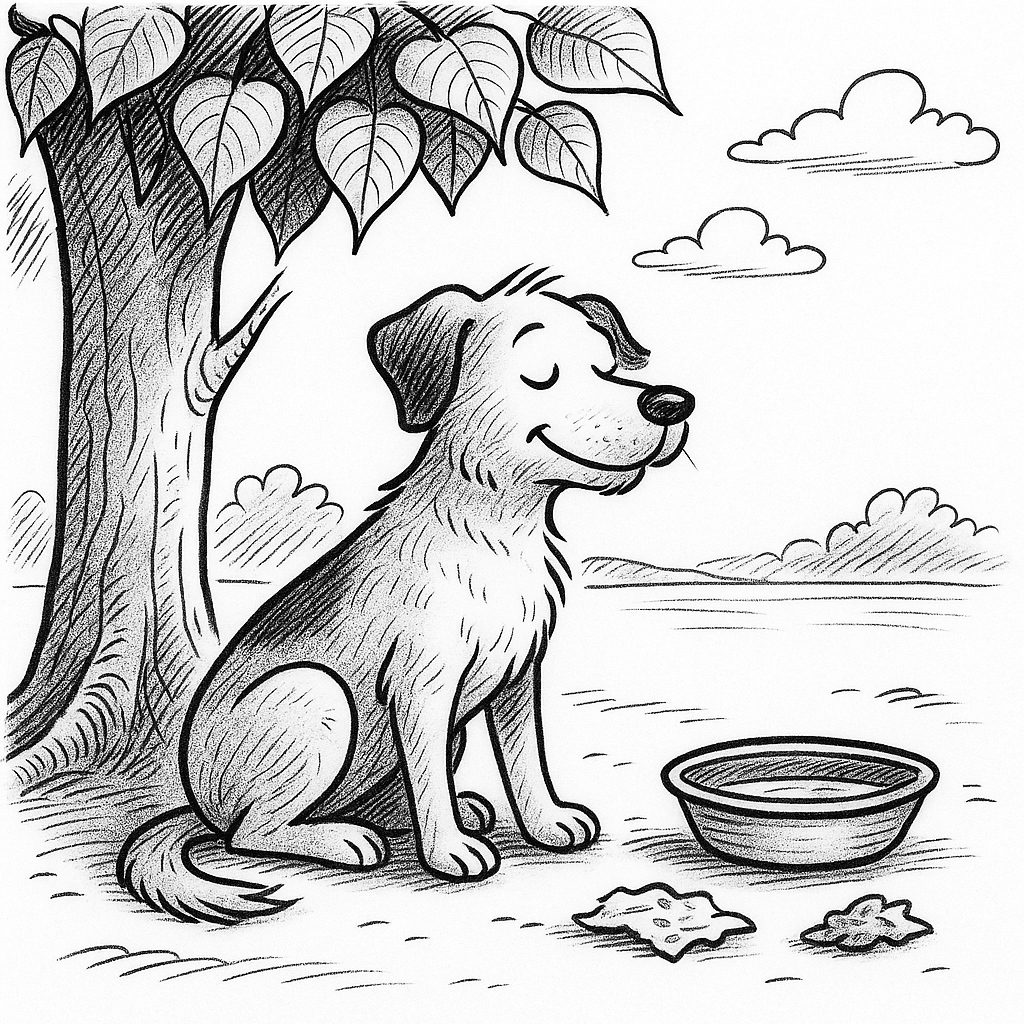
We keep it simple, live each day and enjoy the small pleasures of life – basking in the winter sun, drinking fresh water from puddles after rain, and snoozing under the cool shade of a peepal tree. We sniff for scraps – leftovers – thrown out by humans by design or by default.
We guard the streets and usually keep to ourselves. As with everyone else, we have the right to defend ourselves when provoked. We bark a lot and seldom bite unless it is linked to our survival. Haven’t you heard – barking dogs seldom bite?
As in humans, we too get infected by deadly viruses and bacteria. Rabies is fatal for us and, God forbid, for humans too if they are bitten by an infected member of our species. Thankfully it is a preventable disease. While it rightfully carries a lot of concern, fatalities for humans are much more from reckless driving, tuberculosis and suicides. I heard that the WHO aims to eliminate rabies-related deaths by 2030. Many countries have already been declared rabies-free and India, through its rabies control programme, aims to achieve this target. This will be a big respite not only for humans but also for us.
We love and like to be loved. So in the end, you may love us, you may even ignore us, but please don’t hate us – haven’t you heard – dogs are man’s best friends.
On our 79th Independence Day, we once again got a chance to celebrate our hard-won freedom and all that we have consolidated as a celebrated democracy. We have stood resolute in our principles and are heading towards becoming one of the largest economies in the world
On this day, we are also sadly reminded on how a day earlier, a new nation was carved out of India. We know that it was Jinnah, who in his pursuits, was responsible for the deaths of hundreds of thousands of people and the uprooting of millions more from their homes. The wounds of the tragedy are still to heal.
Most of us however may not know that the word “PAKSTAN” was first used by Chaudhary Rehmat Ali more than a decade before partition took place. Born in Balachur, Punjab, he went off to England to study law. It is at Cambridge in 1933, he, along with a few others took out a pamphlet titled “Now or Never Are we to live or perish for ever”.
The pamphlet was published just after the third Round Table Conference had concluded and had failed to make any headway on the question of the future of India. Rehmat Ali sought to influence British and Muslim opinion in his roughly two-thousand-word piece spread over eight pages.
The pamphlet used contradictory logic and is reflective of flawed concept of a separate nation state which is harped time and time again by our neighbour’s leaders even today.
Rehmat Ali stated to be speaking on behalf of thirty million Muslims of five Northern Units of India-Punjab, N.W.F.P. (Afghan Province), Kashmir, Sindh and BaluchisTAN and thus the acronym PAKSTAN. This was a fantastical premise, as he was neither a politician nor a mass movement leader. He did not represent any region, class or group from the subcontinent.
He tried to elevate regionalism to the pedestal of nationalism. It is mostly agreed that the modern concept of nationalism is a “social contract” between the rulers and the governed. No such “contract” existed in these five units which he names. He falsely claimed that thirty million Muslims of these areas were bound by common history, culture economics and tradition. Nothing could be more far from the truth. An Afghani would be as different from a Punjabi as Spanish from an Italian. He did not mention ‘language’ as a binding factor as he was aware of the many languages spoken in those areas. However, he stated that Urdu was the ‘lingua franca’ of the subcontinent. This dangerous contention would rear its head in 1971 ironically leading to another partition and contradiction of the two-nation theory. He claimed to be speaking for these thirty million Muslims while forgetting that fifty million more Muslims lived in the rest of the subcontinent
Rehmat Ali whipped up the bogey of minority versus majority claiming that Muslims would be one in four in a united India and thus needed a separate homeland. However, he was silent on the ten million non-Muslims who would also be one in four in his so called “nation of forty million” Data was selectively analyzed to convolute logic.
He spoke of fourteen hundred years of contribution to India as a justification for a separate homeland. Again, he forgot that historically recorded contributions to the concept of India or Bharat go back to seven thousand years and more. Our proud Indus Valley Civilization in fact springs up the region he claimed as his religious homeland.
Excluding Russia, he compared Europe to the subcontinent with the same size and population claiming that twenty-six nation states prospered together having the same religion, civilization and economic system. This was a fallacious comparison. European nations had been for centuries been at war with one another despite a common religion. In fact, had religion united, the political geography of the world map would be very different today. Further, Europe prospered only when they integrated into a common market and eventually a common currency. In unity lies strength.
In essence, Rehmat Ali dished out a self-defeating contradictory pamphlet. While the name may have stuck as fantasies do, it had no takers as a concept. Jinnah himself apparently called it a “Walt Disney dreamland”. Pakistan did happen later but further imploded twenty-five years later due to the inherent contractions of the idea of partition.
Rehmat Ali, came back to Pakistan after it was founded and was dissatisfied with its form. He apparently referred to Jinnah as “Quisling-e-Azam” and was soon expelled from the country with his assets confiscated. He went back to England broken and penniless and died a few years later – his funeral expenses were born by a college in Cambridge.
History reminds us that ideas born in pamphlets can redraw maps, but when they rest on flawed logic, they also sow seeds of future implosion. A fantasy that remains a pipedream.
Bindusara, Bindusara, the son of a great king, Bindusara, Bindusara, the father of a greater king; Bindusara, Bindusara, a ruler of glory and might, Bindusara, Bindusara, preserver in his own right.
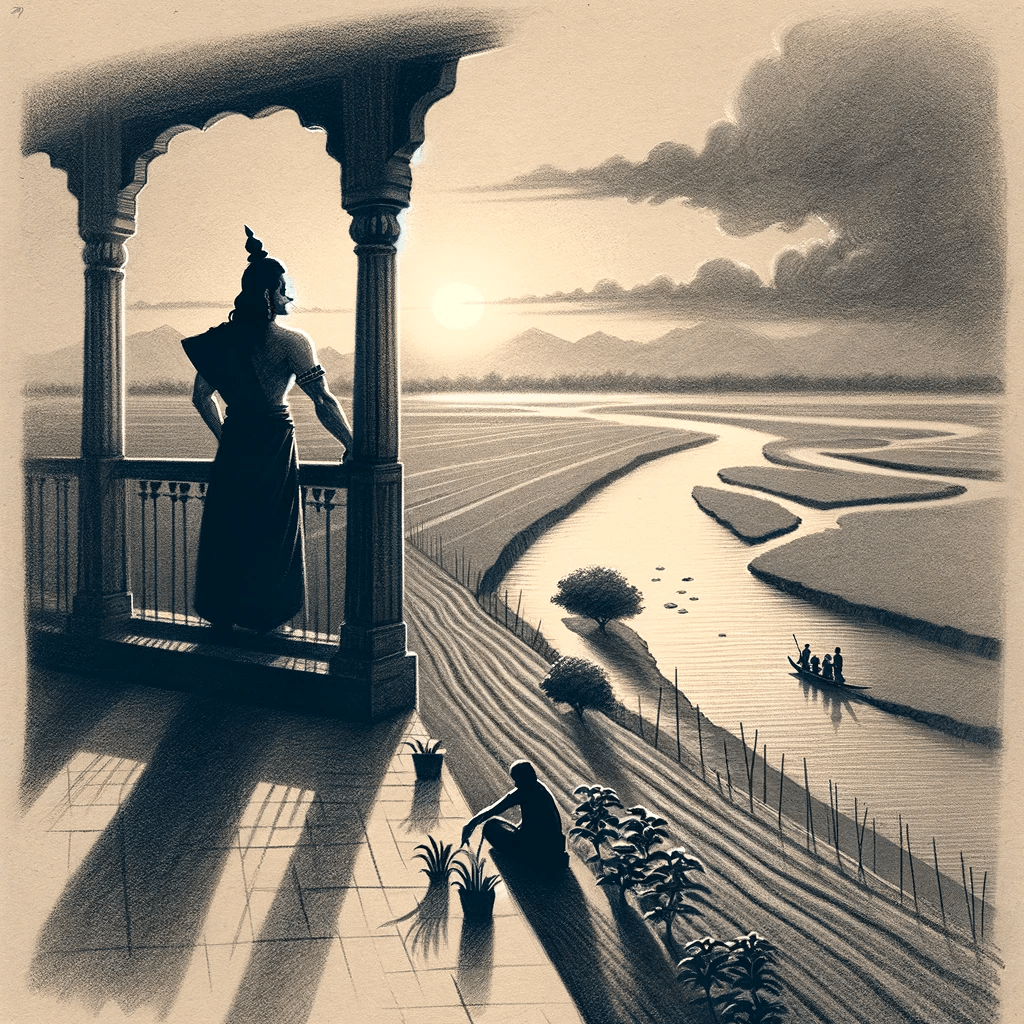
From his palace at Patliputra, Bindusara gazed at the yore. The vast river Ganga flowed at a sluggish pace. It was the lean season, so the channels were narrow, interspaced with vast sand formations. Farmers were planting vegetables taking advantage of the fertile soil. They would then sell the produce, providing nourishment to his subjects and contributing to the growth of his glorious empire.
The summers would soon peak and then it would be time for torrential downpours. This would be followed by winter and another new cycle of seasons. He would grow one year older- adding another year of glory and fame. Yet, as the sun dipped below the horizon, Bindusara felt the weight of his inheritance.
Glory and Fame ! Bindusara inherited a vast empire from his father Chandra Gupta Maurya who was the founder of the Mauryan Dynasty. Chandra Gupta Maurya had overthrown the powerful Nandas to establish his kingdom at Pataliputra. He went on to defeat Seleucus, the Greek viceroy of Alexander, and his empire soon stretched from Bengal in the east to the Hindu Kush in the north west. He was supported by Chanakya, his advisor, mentor and friend, whose statecraft ensured rule of law, diplomacy and an efficient administration. The Kingdom was prosperous and the people happy. Even in death, Chandra Gupta attained glory. Following Bradabahu, the great Jain ascetic, he converted to Jainism, went south, attaining immortality by fasting to death.
Bindusara knew that his father had worked hard to earn his stature. With no lineage like Ajatshatru or Dhana Nanda, Chandra Gupta had risen from an impoverished family, and armed with bravery, skill and intelligence, had worked his way right to the very top. Chandra Gupta Maurya was a Creator and gave his son, Bindusara, a vast empire as an inheritance to govern.
His father had etched his name into the hall of immortality, taking risks, doing things not done before and even seeking death in a most noble way. In contrast, Bindusara’s had none of those exciting chapters. Was it necessary to take the unbeaten path to enter the hallowed portals of fame? Or could he also be praised for the paths not taken, the risks not endured.
His reign had been steady and quiet, but whispers of discontent began to reach his ears. A young rebel leader, claiming descent from the Nandas, had ignited a rebellion in the west. His court urged swift and ruthless action, as his great father would have done.
Fellow kings jeered at him. They whispered around that he was nothing like his father who built the vast empire from scratch. He suspected that many of his ministers felt the same. That was one of the reasons why he relieved the old Chanakya from his responsibilities and asked him to proceed on pilgrimage. He always suspected that Chanakya did not have the same respect for him as he had for his father.
Bindusara felt guilty. Obviously he had none of the achievements of his father to gloat and no exciting stories to tell. In the streets of Patliputra, where he often went out in disguise, he heard his father’s exploits, which were now folklore. In contrast, he scarcely heard praises about himself. Once he overheard his subjects’ yearning for a ruler with the vigour and valour of his father. “Our King does not forge his own path,” one said, “he walks the road laid before him. “This is what happens when one is born in luxury, there is no zeal, no drive, no ambition,” muttered the other in agreement.
And this was the problem. Or was it? No prince would have had it better. Bindusara did not have to fight poverty, forge alliances, make promises and go for conquests to establish an empire. This was all done by his father, who went through this exhausting grind. He was born with a silver spoon in his mouth – quite literally – did he not have lick honey from one, in his “Annaprasan” ceremony.
His father was larger than life who rose like a phoenix from the ashes to accomplish great things. In contrast, he was already on a golden pedestal with rivers of aplenty flowing around. Was it his fault that he was born in royalty? Was it his fault that he had no rags to riches story to enthuse the rabble? He had the best of education, learnt how to fight and engaged in deep conversations with the wise men of his court. His administration was firm and efficient and its borders were secure. His people were happy or so he thought. And yet this rebellion?
How he wished for wise and sane counsel. The courtiers around would fawn over him, each currying for a favour – each having their own personal axes to grind. They were all “Yes men” who were like opium – giving instant gratification while befuddling his brain. He asked his friend, the Macedon king Antiochus-I for sweet wine, dried figs and a sophist. He got the excellent wine and figs but a sophist was not sent – apparently forbidden under Greek law.
He was “Bindusara” which meant “strength of a drop”, referring to the drop of poison which touched his head when he was born. He not only survived but also flourished. The Greeks called him Amitrochates – derived from his Sanskrit name “Amitraghata”, slayer of enemies. Was he expected to live and die by these epithets ? Should he not gather his army, crush the rebellion? He could do one better than his father and conquer the unconquered lands. The south lay out of his grasp as did the troublesome Kalinga due east. Should he add these to his great kingdom and etch his name alongside his father?
Or he could be the “Preserver”. Lord Vishnu and his ten avatars were as much revered as the “Creator” Lord Brahma and the “Destroyer” Lord Shiva. He could preserve what had been bestowed upon him and pass on the legacy to his heirs.
Tormented by the words on the street, the whispers in the court, the internal tumult, and driven by a desire to prove his worth, Bindusara resolved to face the rebellion with understanding. He embarked on a secretive journey to the rebellious region, dressed as a common traveller.
Along the way, Bindusara saw the plight of his people: the harsh taxes and the brutal enforcement of laws that spurred the rebellion. In a dusty tavern, he met with the rebel, a charismatic young man whose grievances echoed those of his followers. They spoke at length and spent considerable time together.
Amongst other things, some of his words struck deep. “Your subjects toil hard from morning to night for two square meals a day, ” the rebel said. “They marry and have children who carry on the same drudgery that would be repeated generation after generation. Leadership, conquests and glory are as foreign to them as the Greeks to India. Their expectations of their king are limited to remain secure and earn their living peacefully. But the wars, the taxes which they entail, the loss of life and crops, not to mention the harsh punishments, all add to their misery”. For the first time, Bindusara viewed his empire through the eyes of those it had failed.
Returning to Patliputra, Bindusara called his advisors together. “We will not crush this rebellion with force,” he declared. “We will address the root of this discontent. We will ensure fair treatment for all. We need not innovate or enforce with impunity but improve the efficiency of our administration.”
His decision shocked the court but marked the beginning of a new approach. The gentle reforms had its desired effect. Nothing spectacular. Just better implementation with an ear to the ground. The rebellion dissolved as quickly as it had formed. The kingdom was peaceful once again. He liked the term which was now associated with his rule – “enlightened despotism”.
Bindusara further proclaimed that he would not embark on any new major conquests. His father had spent much of his life conquering and building his great empire. This left him with little time for his family. He did not understand what further purpose he would gain by mounting the horse of ambition and chasing unattained glory. Bindusara resolved to devote time to his family. His family of subjects and his family at home. His success would be in balancing both…..
Years later, Bindusara walked the same palace balconies. The kingdom was stable and peace prevailed. There were occasional revolts which had to be put down with force, but only as a last option. Generally, gentle counsel prevailed. Bindusara pondered again. Would he be remembered in the annals of history and in what manner? As the son of his father, or as the father of his son? Or would he be remembered as Bindusara, the king who not only preserved what was bestowed upon him but flourished. He was no longer just the heir to Chandra Gupta’s empire; he was Bindusara, the ruler who bridged the old with the new. He hoped to pass down not just an empire, but a legacy of compassion and wisdom.
Epilogue
Bindusara rule spanned more than two decades. Apart from his father great Chandra Gupta Maurya and his illustrious son – Ashoka the Great, no other Mauryan king reigned for as long as he did, nor are the others remembered as were these three spectacular kings. While Chandra Gupta Maurya conquered and Ashoka the Great spread “Dhamma”, it was Bindusara who was the bridge between the two, who preserved and nourished the stage, given to him, enabling his son to attain world fame. And that is how he is remembered, for being Bindusara !
(The following story is ‘inspired’ from the real life of Shri Dudhnath Tewary.)
I
Dudhnath tossed about restlessly as he tried to get some sleep. His companions, meanwhile, took turns to keep watch. For the past few days (and nights) it had been an endless cycle of running, hiding in villages and again running. The British reinforcements were hot in pursuit for they were mutineers in the eyes of the East India Company Law. They had rebelled and deserted their posts in the Jhelum rebellion of the 14th regiment of the Native Infantry.
The rebellion, later celebrated as the 1857 War of Independence had begun on a high note. They had heard about the courage of Mangal Pandey’s initiative, and they were certain that their castes were being defiled. “Were not the British providing them with cartridges greased in animal fat – to be bitten before loading ?” Dudhnath and his companions had hoped that their regiment would rebel en masse and they would join the other soldiers in their march to Delhi. It had been exactly one hundred years since Plassey and the “shatak” (century) was a good omen that Indians would be masters of Hindustan once again.
As it happened elsewhere too, there were rats who connived with their colonial masters for scraps. Their uprising was quelled in a few days. Most were captured and hanged. Dudhnath and his companions had no choice but to flee and try and make it to either Kanpur or Lucknow which were becoming nerve centres in the War for Independence being waged.
Troops of the 14th Regiment of Bengal Native Infantry
However, fate willed otherwise. He had dozed off and so had his companions. He was awakened by the pointed poke of a bayonet and kicks to his behind. As he opened his eyes, he saw dozens of soldiers around him and his companions – rifles aimed and ready to shoot. For him, the War was over even before it begun!
II
The next few weeks were a nightmare. They were tortured, physically and mentally. He saw many of his companions being brutally hanged in public places. For some reason unknown to him (as he did not understand a word spoken at the summary military trail) he was not hanged but given a sentence called “transportation for life”. A native soldier, on the right side of the Company, gleefully explained it to him quite succinctly – ” Off you go to a faraway island which the British are using as a prison. It is scarcely populated; the weather is hot and humid and there are cannibals in the jungles waiting for treats like you from the mainland. And you will definitely lose your caste as you cross the Bay of Bengal. The best part is, that this will be for life. There is no coming back. Enjoy the rest of your miserable existence in the Godforsaken land. The only redemption is that probably you will not suffer long enough – tribals, animals, weather and the prison will take you out very soon”. Dudhnath, shuddered at the thought. Was this the price to pay for fighting for his own country?
III
Dudhnath was sent to Karachi and finally after six months since he was first captured, he was shoved onto the ship Emperor Roman. Dudhnath, a poor sepoy, was ignorant of world history to realise the irony – a ship named after an empire which had dominated Britain itself. Roman Emperor set sail from Karachi to the unknown beyond….
Image credit – The Andaman Islands – Illustrated News 1858
IV
He reached the Andamans after an agonising journey in iron fetters. The sea crossing had been horrendous. He lost his caste and vowed a Mahamritunjaya Yagya (sacred religious ceremony) when he would go back home. Yes, he would go home one day he mused. The black waters of the Bengal Bay would not be his death. No amount of “Kalaa Paani” would stop him from going back. He was a survivor.
Along with him were other convicts, most of them warriors like himself. He was given a number “276” at Ross Island. Life was oppressive as promised. Insects buzzing around, fresh water was scarce -the only source being rainwater stored. They had to do manual labour – which included cutting tall trees whose wood was so hard, that their axes often broke. Within a week, he was fed up. He started conversing with other convicts whenever he got a chance and soon found out that an escape was being planned. He immediately agreed. They surmised that that the land which they could see beyond the island was Burma (present day Myanmar) and the local raja would support them in their bid to go back to India. After all Burma had suffered two defeats in 1826 and 1852 at the hands of the British and would still be smarting from those blows to their sovereignty and prestige.
Dudhnath ignorance of geography- Burma was not next door !
Ninety odd convicts were soon onboard. They secretly made rafts using felled trees and bamboo. A sympathetic Indian guard had a whiff of the impending plan but kept quiet. After a few days, the rafts were ready and hidden at the shore. When the sun was down, and the guards were lax, they silently and stealthily made it to the shore in batches. They took with them pots of drinking water, rice and some implements for protection and travel. They pulled out the rafts on to the channel and started rowing quietly hoping to reach the ‘mainland’ a few kilometres away in quick time. They did that, barring a few mishaps including a raft capsizing and a convict being pulled into the water by a huge fish. Though they did lose a considerable portion of their rations with the raft, they were more relieved than exhausted as they pulled up onto the beach and hid in the undergrowth beyond. A few were asked to keep watch while the rest dozed off happily – after all they had won their freedom.
V
Dudhnath woke up to the sounds of pleasant chirping birds and irritating mosquitoes. The sun was up and fierce. The azure blue transparent sea offered little solace. They quickly drank some water from their rations and decided to head inland towards Burma. The were greeted by dense forests with trees as tall as their gaze could go. Sunlight scarcely peered through, and the ground was an undulating landscape of roots, shrubs, vines and ferns. They trooped northwards, but soon lost sense of direction or time. After two days of painstaking progress, they heard the sound of humans. It could either be the Islanders, whose aggression and hostility were folklore, or the British who may have sent a capture party to take them back. Thankfully it was neither. While they got ready with their axes and knives, they were confronted by – another batch of escapees, about forty in all. They hugged each other and soon found out that they had escaped the Viper and Chatham Islands and were also on their way to Burma. With renewed enthusiasm, the hundred and three dozen odd band of fighters, set off again in their flight to freedom.
The convicts escaped from Viper, Chatham and Ross Islands (as they were known as in those times)
VI
Duthnath knew something was wrong. They had been walking for two weeks and Burma was still not in sight. The jungle did not thin out and the same formidable trees, irritating insects and cacophony of birds persisted. Wherever they went, they were confronted by sea, and they soon realised that they were on a large Island rather than any mainland. They ran out of whatever rice they had, and the pots of water were soon empty. There was no rain and a few who drank from the sea retched and were left to die. They could not carry the sick to hinder their progress. A few climbed the tall trees and used the axes to obtain water stored in the branches and climbers. Some water was also obtained from rivulets on the sides of the hills. But they were soon hungry and thirsty, and their heat was adding woe to their worries. They also found a few huts which they believed to be of islanders but thankfully there were no “savages” in sight.
However, luck soon ran out and as they were walking through the jungle, they were confronted by almost an equal number of native islanders. All armed to teeth with bows and arrows. Resistance was useless and so they prostrated themselves in an act of clemency as word of the tongue was useless. The natives, however, maybe captives of their past experiences, attacked the escapees from all sides. It was as if orders had been issued to leave no quarter.
Dudhnath was hit thrice, in his shoulder, elbow and around his eyebrow. He somehow managed to flee the carnage and as he dashed through the undergrowth, he heard the cries of his fellows as they were mercilessly slaughtered. After running for ten minutes, he was joined by two other escapees. Quite sure, that they were not being followed, they sat down to recess their hopeless situation. Burma seemed as far as India now, and going back to Ross Island would mean a certain hanging by the noose. The Islanders had shown their intent and so another confrontation with them would also mean death. So, they decided to go the shore, build a raft and hope to be picked up by a ship from a friendly country be it Burma or Siam (Thailand). Or maybe an Indian princely state vessel, not under the East India Company flag, could pick them up if they were lucky. If nothing else, they would scourge the numerous islands and try to settle on one where there were fewer hostile tribes or were uninhabited.
So, the three of them, trudged along a saltwater creek which led them to the shore. And there, as if fate was still not done playing mischief, they stumbled headlong into a group of islanders who were drawing up their canoes after a day’s hard work at sea.
VII
Dudhnath gathered his breath as he looked around. The past fifteen minutes had been horrendous. They tried to flee but were cut off by the group which numbered up to fifty souls. The hapless three prostrated with folding hands and pleaded for their lives, but his two companions were killed from arrows straight to the heart. Dudhnath spied a hole under a fallen trunk a few meters away and dived headlong after breaking out from cordon. Now in this hole, he could sense the group waiting for his next move – which was none. Dudhnath had no options and death was now a certainty. He wished he was killed on the battlefield rather being subjugated to the ignominy of being killed by a non-white. He gingerly brought out a foot, but a flurry of arrows came through, one scratching him in his thigh. He then came out headlong, with his hands folded in supplication, with an endearing look at the group. He closed his eyes and muttered the Gayatri Mantra, remembering his parents as he waited for the arrow to pierce his heart. However, much to his surprise, no fatal blow came. Dozens of arms dragged him out and carried him off to their boats. Dudhnath had survived again, for now….
Photographic Representation of the Tribes of the Andamans
VIII
Dudhnath, not only survived that day, but thrived as days turned to months. He assumed that he had been accepted in the tribe as he was neither killed or confined. He was shorn of his clothes and hair shaved from his head. He went around from island to island along with the group, who led a nomadic existence, camping at one site not for a prolonged stretch of time. He ate the same food as them (no, they were not cannibals) and slept in the same clearings. He was taken on hunts though he was not allowed to bear any arms. They would make forays into the jungle but always come back to the seashore at sunset. He picked up a word of two of their language and as days went by, his fears started to dissipate. His wounds soon healed, helped by the pastes applied by the tribals, made from roots and herbs. He regained his strength. He was amazed to see the agility of the Islanders, their love for family values and their organisational skills. Life was not luxurious but was comfortable as it could be in the surroundings. It was not all death and illness as he had often heard in India. These were human beings, just like any other race, proud of their kin and their surroundings. However, they were extremely protective about their habitat which explained their hostility to external interferences. One day an elder, called him out and pointed his daughter towards him. A clearing was made in the center of their current camp, and he was made to sit with her. He had seen this before and knew he was being married to the elder’s daughter called Leepa. They sat quietly for a few hours as was the custom. They still did not trust him, as there were no bows or arrows in the middle as was the norm for the ceremony. By evening, he supposed that Leepa and he were husband and wife.
IX
It had been many months since Dudhnath had escaped and had been captured by the Islanders. Throughout the year, he visited many islands along with his newfound kinsfolk. He was married five times, each ceremony taking place exactly the way it was performed the first time. Still no bows and arrows! He grew accustomed to the life he was leading but he knew that this was not home. He was still a prisoner of the islands. The fact that there were no chains, and the masters were not white, brought him little solace. He yearned for his village, his farm with large swathe of paddy swaying in the wind, and most of all, home cooked food prepared in ghee by his mother. The familial bliss attained in the last one year could not overcome the pangs of separation from home. This was not home away from home. But what could he do? He could not escape as he had still not sense of geography, nor was he willing to risk his life with a confrontation with another group who may not be as merciful as this one. Dudhnath did not share his thoughts with anyone. The language barriers made it quite impossible to communicate the simplest of things, and anyways they would not understand what he felt. Biding his time, Dudhnath continued to go about his life in the jungle.
X
Dudhnath could see the mighty Ganga in the distance. His friends were jumping into the water to escape the pre-monsoon heat. He could smell the whiff of milky tea and piping hot samosas. He extended his arm to grab one, but something was wrong. The landscape rapidly turned green and the gastronomic whiffs faded away. He woke with a start to find that his “wife” was gently shaking him. She motioned him to get ready. So much for his samosas, he cursed. A few minutes more, and he would have eaten one too, even if was in a dream. Soon he joined the rest but this time he observed that a few other groups had gathered and there was an unusual excitement in the air. The armoury which included bows, arrows, crude axes and spears were also more than would have been required for a daily hunt and seemed that preparations were on for a long time. Maybe they were planned an inter-island raid he speculated.
He went with the menfolk and got onto the boats. It was still quite dark, and the sun had still not risen from the sea. But something was wrong, instead of going to the other islands they were heading in the direction from where it all began – they were going towards Port Blair and Ross Island. And soon there were canoes from all sides, and they were now numbering a thousand, not a few hundreds. Dudhnath had picked a bit of the local dialect in his yearlong sojourn. He soon realised he was part of an attack party, and the target were the British. As they neared Port Blair, Dudhnath’s gut churned. Yet another battle, where death would again be lurking around the corner. He relished the prospect of killing a few colonialists, but what if he was killed? And even if he did survive, he would be back to the jungle, eking out a life in the humid jungle, waiting for the next battle. He had seen the viscousness of the British, and he knew that they ultimately would prevail over the Island. What if he was captured, during the battle, then death as a fugitive convict was even more certain. Dudhnath, the survivor, mulled over his options and gradually a sketchy plan began to take shape. It was risky, but he was convinced that this was for the best, whatever the consequences.
XI
The Islanders silently converged near Port Blair. They were seething for revenge against the Whites and their Brown lackeys who had been cutting down their beautiful habitat. The land had been theirs, for times immemorial. They had resisted the Malay pirates centuries earlier and also the curious savage explorers who had taken some of their kin in chains. More than seven decades ago, they had successfully ensured that the first white settlement did not take permanence and so this time too, they would prevail. They had taken in this brown native, despite pleas from older folk to show no mercy. However he looked harmless and had integrated into their tribe while they still kept a close watch on him. ” Never trust the outside man” had been the mantra that had been passed on through generations. They brought him along for the attack, as they did not want to leave him behind with the women. They all thought him of a dull pitiable soul, so one more to the party did not make much of a difference.
As they neared the barracks, Dudhnath jumped into the water and went beneath the surface. It was dark enough and thus the Islanders on the boat couldn’t pinpoint his location. Still, he remained submerged and swam away from the boats with all the strength he could muster. An occasional arrow came zipping in for a minute after he jumped, but then there was silence. Thankfully the fishes or the crocodiles must be sleeping, and he did not meet a watery grave. After twenty minutes, he reached the shore and ran to the Office of Mr. Walker, the superintendent. He knew he may be running to his death, but he ran on and on…
Ross Island
XII
Superintendent Walker was grumpy. His dinner had been more like the gruel offered to Oliver Twist. Life in the Andamans had taken a toll on him. Away from what he called civilisation, it had been an endless rigmarole of disciplining convicts, manning his disgruntled soldiers and thwarting the Islanders who were resisting attempts of colonisation. He had just finished his morning tea when an unkempt man came running to his office hotly pursued by two guards. The person who tumbled in looked like a cross between a Hindustani and an Islander. He was in the elements of nature with barely a few scraps of barks and leaves on him, his head was shaved, and his body had tattoos, the tell-tale of the tribes. The guards apprehended the person and roughly searched him for arms, but he was clean. Walker had seen this guy somewhere but couldn’t place him immediately. The usual course of action would have been instant arrest and interrogation later, but the terror in the eyes of the person and his pleadings made Walker curious. Motioning to his guards to pause, he asked the fellow to slow down his blabbering and make sense. For the next half hour, Walker’s eyes widened in astonishment as Dudhnath recounted his extraordinary story.
XIII
The confrontation with the Islanders that day would come to be known as the Battle of Aberdeen. Dudhnath’s timely warning enabled the colonists to divert and concentrate crucial resources and thwarted the biggest challenge yet so far to their authority. The exploration, expansion and exploitation of the Islands continued unabashedly in the years to come, and the Islanders were not able to mount an attack of this scale ever again. The Administration recommended an unprecedented pardon to Dudhnath, who otherwise would have gone to the gallows as a recaptured convict. Delhi, in order to demonstrate the benevolence of Imperial rule, made an exception and granted the “Hero of Aberdeen” his freedom. Dudhnath’s exploits became a topic of dinner parties from Lucknow to London and a subject of many weeklies and journals. He returned to his village, a legend. He had thrice survived – the rebellion, the Islanders and finally the gallows and thus was thrice reborn. An elaborate religious ceremony regained him his caste too. He regaled the young and old with his “heroic stories” on the banks of the river Ganga, while munching his hot samosas along with milky sugary tea. The Administration kept an eye on him for some time but realised that he was past his prime and had his life’s worth of excitement. Though they did occasionally call him for cross referencing the elaborate records that they were keeping on everything – including the Andamans.
Dudhnath was summoned once more, but this time requested (more like a direction) to go to Andaman to help the local administration in some anthropological/scientific mission. His time with the Islanders would provide invaluable information to the scientific team stationed there. He travelled across the Bay of Bengal once again, this time without fetters and in relative comfort. As the islands loomed before him in the horizon, he had a feeling of dread which he could not explain. Port Blair was expanding, and the British were firmly in control. He was taken to a group of Islanders who were being “civilised”, and he recognised a few women from the group with whom he had stayed during his sojourn. He learnt that Leepa had given birth to his child. Leepa was there too, she did not say anything, just came to him and spat in his face. The disgust on the faces of the Islanders made him shudder. Obviously, thereafter there was no further conversation with the group. Dudhnath the survivor, quietly walked away. The rest of his trip was uneventful, and with mixed feelings, he returned home.
XV
The churning within, kept Dudhnath awake for many nights. His happiness of surviving the ordeal was now laced with pangs of guilt. As he grew older, his stories were soon forgotten, consigned to the appendices of history. India would have much bigger things to ponder – the national movement, mass mobilisation by Gandhiji, revolutionaries, and eventually partition and independence. Dudhnath did not have the luxury of foresight but knew that one day the Islands along with Hindustan would be free. He fervently prayed that history would not judge him harshly. He hoped that free Hindustan would take steps to preserve the indigenous people and their habitat. That would be his atonement. That would be his deliverance.
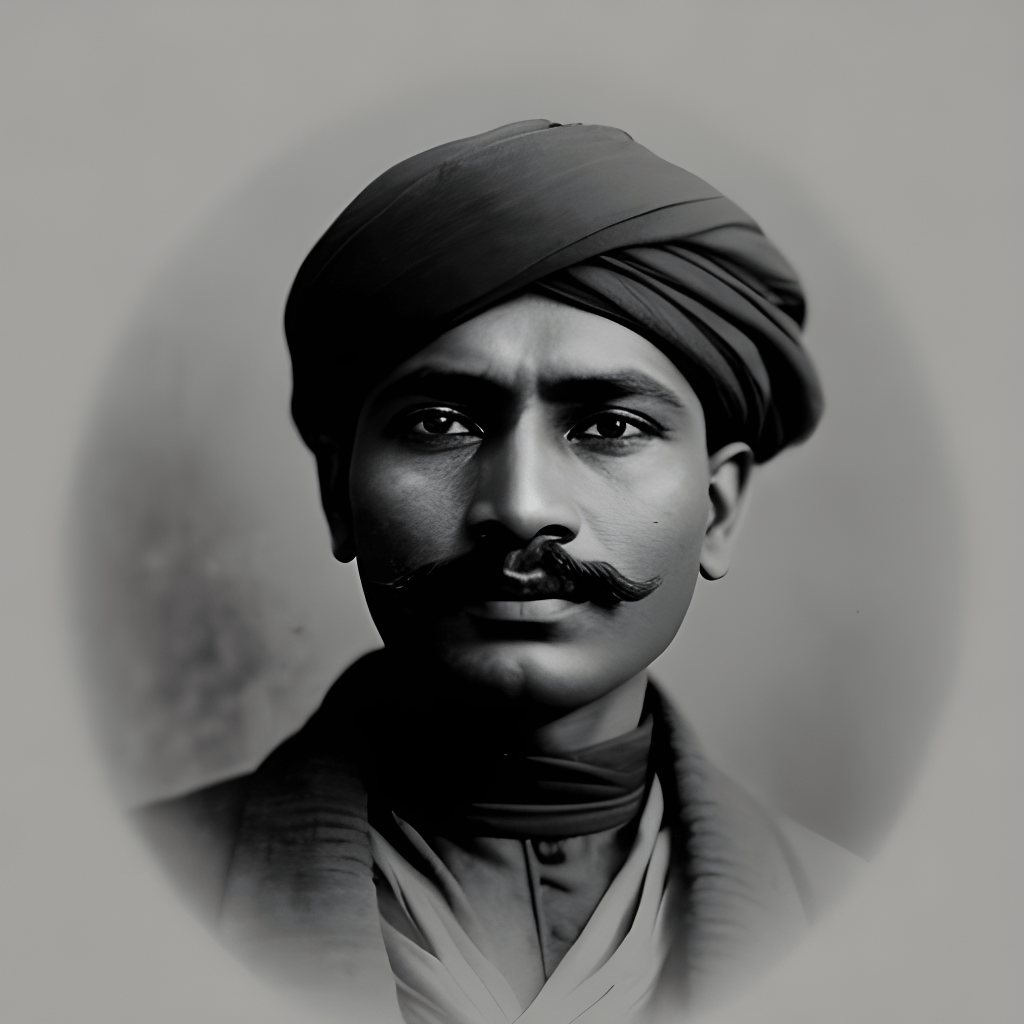
An AI impression of Dudhnath Tiwari based on available descriptions