Tag: geopolitics

  • A Cauldron of Gases – Part 2: 
The Geopolitics of the Flame – The Chokepoints

    A Cauldron of Gases – Part 2: The Geopolitics of the Flame – The Chokepoints

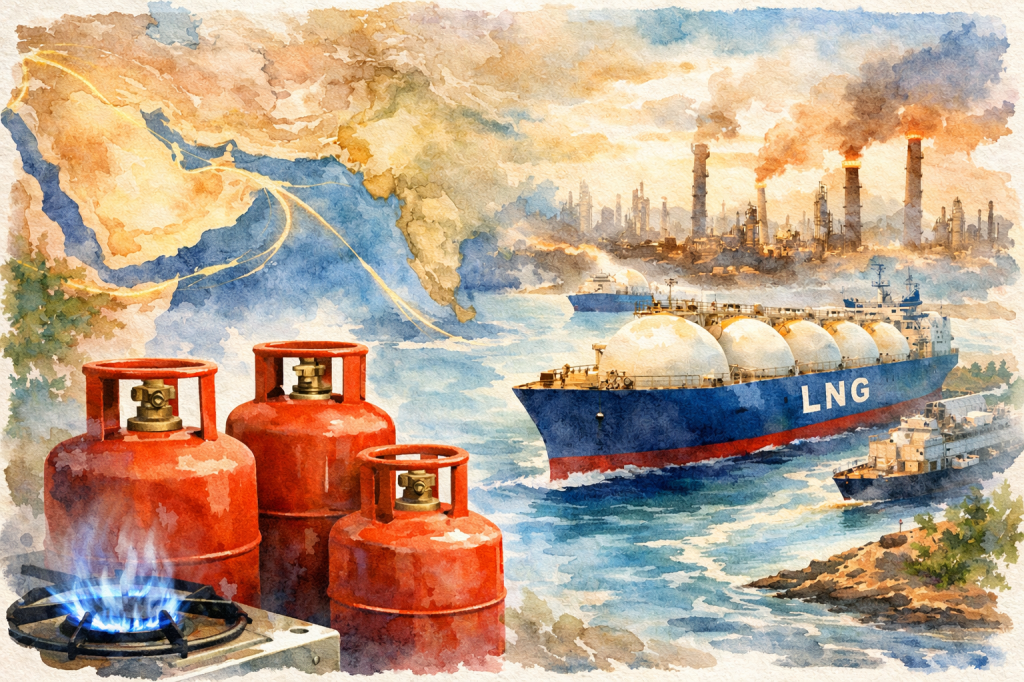
    If Part 1 introduced the actors, in Part 2 we examine some of the major chokepoints through which they operate—an interconnected global system where geography determines the ebb and flow of energy and trade. In the modern world, narrow waterways often become strategic valves controlling commerce, industry and national power.

    In an ideal world, liquids and gases, unless restrained, flow freely. However, we do not live in a Utopia. So, in the real world, geography charts (and constrains) the flow of water on the Blue Planet. Some of the important pieces in this unique geographical jigsaw are:

    Strait of Hormuz: The Oil and Gas Valve

    (Map is not to scale and boundaries are only representative)

    The Hormuz Strait has been in the news lately due to the current West Asian imbroglio. This narrow maritime passage not only separates the Asian landmass from the Arabian Peninsula but also historically marked the interface between the Persian and Arabian worlds. A few theories have been put out with respect to its interesting etymology. Hormuz may have been derived from the Middle Persian pronunciation of the name of the Zoroastrian God Hormoz (Ahura Mazda). Alternatively, it may have been derived from the local Persian word Hur-Mogh ‘Place of Dates’. Another theory says that it was named after Ifra Hormizd, the mother of King Shapur II of Persia or after the Greek word for cove or bay.

    Around about 160km long, it is 40km wide at its narrowest, making inbound and outbound vessels follow a distinct course to avoid collisions and shallow waters. Around 20 million barrels of oil transits this narrow passage every day, representing around 20% of global petroleum consumption. Similar is the case for LNG. Around 80% of LNG bound for Asia transits Hormuz with Qatar dominating production. Specifically for India, 50-60% of LNG as well as LPG along with 30-35% of crude oil passes through this vital Strait which is a vital waterway (and a potential chokepoint) for fuel resources.

    Suez Canal Route: Moses Parted the Sea, Humans Parted the Land

    (Map is not to scale and boundaries are only representative)

    If the Strait of Hormuz is a natural chokepoint forged by geography, the Suez Canal is an artificial one engineered by human ambition. Strictly speaking, Suez is not a strait, as it is not a naturally occurring narrow water passage between two land masses. Rather, it is a man-made canal, linking the Mediterranean Sea at Port Said to the Red Sea at Suez, thereby connecting Europe directly with Asia. Long before the canal was established, sailors in search of spices and riches had to circumnavigate around the tip of Africa (called the Cape of Good Hope) to reach Asia.

    The canal derives its name from the Egyptian city of Suez, possibly originating from the ancient Egyptian term Suan meaning “beginning,” referring to its position at the head of the Red Sea. Other linguistic theories exist, though many remain speculative.

    The Suez Canal was a French project completed in 1869 under Ferdinand de Lesseps when colonial powers were searching for shorter routes to Asia. Its opening fundamentally altered maritime geography, shortening Europe-Asia voyages by nearly 7,000 kilometres and transforming Egypt into a geostrategic fulcrum of world trade. Sailing from Europe down the canal, one encounters another narrow constriction in the Red Sea between Yemen and Djibouti/Eritrea called the Bab-el-Mandeb, also known as the “Gateway of Tears”.

    Approximately 193 kilometres long, the canal traverses the Isthmus of Suez and today handles roughly 12-15% of global trade and 10-12% of global seaborne oil trade, according to multilateral shipping assessments. It is particularly critical for crude oil and refined petroleum products moving from the Gulf to Europe; LNG cargoes destined for European and Mediterranean markets; US and Atlantic Basin LPG/LNG shipments moving toward Asia and containerised trade between Europe and Asia.

    While not facing the same challenges as its cousin Hormuz, the waterway down the Red Sea at Bab-el-Mandeb has faced insurgency and piracy which have hampered trade and commerce from time to time.

    The Panama Canal: America Triumphs Geography and Europe

    (Map is not to scale and boundaries are only representative)

    The Suez project was designed, directed and produced by European imperialism. In the decades that followed, the United States, first through the Monroe Doctrine and subsequently through the Roosevelt Corollary, demarcated and enforced its sphere of influence.

    The Panama Canal became a physical manifestation of America’s transformation from a continental republic into a global geopolitical and maritime power.

    For centuries, imperial powers sought a shortcut between the two oceans. Erstwhile, ships which wanted to go from Europe and America to Asia had to sail around South America’s Cape Horn. The perilous journey of nearly 15,000 kilometres forced ships to endure the violent gales of the “Furious Forties” and “Screaming Sixties,” along with the hazardous waters around Cape Horn and the Magellan Strait.

    A French attempt led by Ferdinand de Lesseps collapsed amid engineering difficulties and tropical disease. The canal was eventually completed by the United States in 1914, using an elaborate and sophisticated system of locks and artificial lakes to lift ships across the continental divide.

    One widely recounted theory suggests that “Panama” originated from an indigenous word meaning “abundance of fish,” while another associates it with the “place of many butterflies.” The precise etymology, however, remains uncertain.

    Roughly 82 kilometres long, the canal today handles around 5–6% of global maritime trade and remains especially important for container trade, grain shipments and increasingly for US-origin LNG and LPG exports destined for Asia following the American shale boom.

    The Canal illustrates the fragility of engineered chokepoints. Unlike Hormuz or Bab-el-Mandeb, where the primary risks are geopolitical or military, Panama increasingly faces climatic and hydrological constraints. The canal depends heavily on freshwater from surrounding lakes to operate its lock system. Drought conditions linked to El Niño and changing rainfall patterns have periodically reduced water levels, forcing restrictions on ship transits and cargo loads. Such has been the canal’s strategic importance that Panama has historically witnessed repeated external political intervention. Today, the Canal faces threats, real and perceived, over its control by traditional and emerging economic superpowers.

    The Strait of Malacca: The Gateway to the East

    (Map is not to scale and boundaries are only representative)

    While Hormuz is the valve of Gulf energy and Suez and Panama are engineered bridges between continents, the Strait of Malacca is the crowded maritime funnel which breathes life into the economies of the East. Stretching between the Malay Peninsula and the Indonesian island of Sumatra, it links the Indian Ocean with the South China Sea and the wider Pacific.

    The Strait derives its name from the historic Sultanate and trading port of Malacca on the Malay coast, once among the wealthiest entrepôts of the spice trade. The word itself is believed to originate from the Arabic Malakat, meaning “congregation of merchants” or “meeting place of traders,” or from the Malay Melaka, associated with the Indian gooseberry tree under which, according to legend, a Sumatran prince rested while founding the settlement. Over centuries, the region drew Arabs, Gujaratis, Chinese, Portuguese, Dutch and British traders, making Malacca one of the earliest true crossroads of globalisation.

    Roughly 900 kilometres long, but narrowing to barely 2.8 kilometres at the Phillips Channel near Singapore, the Strait today carries around 25% of global maritime trade and is among the busiest shipping lanes in the world. More than 80,000 vessels transit it annually, transporting crude oil from the Gulf to East Asia; LNG cargoes toward China, Japan and South Korea; containerised trade between Asia, Europe and the Middle East and manufactured exports from East Asia to the world.

    For energy markets, its significance is immense. A substantial proportion of oil and LNG bound for East Asia—including shipments from the Gulf transiting Hormuz—passes through Malacca. It is therefore a critical artery for the energy security of China, Japan and South Korea.

    Strategically, the Strait occupies a central place in what has been called the “Malacca Dilemma”—the fear that hostile naval powers could disrupt China’s energy lifelines at this narrow maritime bottleneck. This vulnerability has partly driven Chinese investments in alternative overland pipelines, ports and the broader Belt and Road Initiative.

    Malacca faces its own unique set of challenges ranging from congestion and navigational hazards to sea piracy and naval competition. Any major disruption could force vessels to reroute through the longer Indonesian archipelagic passages, increasing voyage times, fuel consumption and freight costs substantially.

    For India, Malacca represents not merely a distant Southeast Asian waterway but the eastern gateway connecting the Indian Ocean to the Pacific trading system. Its strategic importance explains why the Andaman and Nicobar Islands occupy such a pivotal location in India’s maritime calculus.

    Together, these chokepoints reveal a fundamental truth of the modern world: energy does not merely flow through pipelines and tankers—it flows through geography itself. From Hormuz to Malacca, narrow waterways have become strategic valves controlling trade, industry and national power. In the next part, we examine what happens when these arteries are strained, disrupted or weaponised.

  • A Cauldron of gases

    Part 1

    Dramatist Personae – the Gases

    Recent events in the Persian Gulf have brought to the fore discussions on energy and by extension, fuel and gases. Though they do not figure in the calculation of core inflation, their production and supply have worldwide ramifications. It is necessary to understand what these gases are, how are they produced and supplied and their uses.

    Let us first dissect three words going around. NG, LNG and LPG. Natural gas (NG) is basically methane, the stuff that contributes to the greenhouse effect and what many planets like Uranus and Neptune are engulfed with. Despite these major infirmities, it is critical as a fuel for cooking and transport, electricity generation and fertilizer production. Since it cannot be transported easily in gaseous state, it is cooled to -162 degrees into Liquified Natural Gas (LNG) which is supplied around the world in super tankers.  The LNG is then converted back to gas at import terminals. In large city networks it is supplied to homes through pipes as Piped Natural Gas (PNG). For transportation it is used as Compressed Natural Gas (CNG).  

    Natural Gas is extracted from underground gas reservoirs or oil and gas basins. These are in the Middle East, Russia, North America (through shale extraction) and Australia. In India, natural gas is produced from offshore and onshore basins such as the Krishna–Godavari Basin, the Mumbai Offshore Basin and the Assam–Arakan Basin.

    Natural gas consumption in India is currently around 195 million standard cubic metres per day (mmscmd).  Roughly half of the demand is met through LNG imports with a large share coming from the Gulf region. Qatar alone accounts for about 39% of India’s LNG imports. Other major suppliers are Australia, United States, Russia and Oman.

    Liquified Petroleum Gas (LPG) by contrast, is a different fuel composed mainly of propane and butane – higher cousins of Methane. It liquefies at moderate pressure and ambient temperature, which allows it to be stored easily in pressurised cylinders. This makes LPG particularly suitable for household cooking.

    While LNG is largely used by industry and power plants, LPG is the primary cooking fuel for hundreds of millions of Indian households. India’s LPG consumption has grown sharply over the past decade with demand reaching about 31–33 million tonnes annually, driven by expanding household access. Domestic production remains limited at roughly 12–13 million tonnes per year, meaning the country imports around 20–21 million tonnes annually, equivalent to roughly 60–65% of total consumption. This makes India one of the world’s largest LPG importers.

    The expansion in demand is closely linked to the rapid increase in LPG connections. The number of LPG consumers increased from about 145 million in 2014 to more than 320 million  by late 2024, more than doubling within a decade. Much of this expansion occurred under the Pradhan Mantri Ujjwala Yojana, which sought to replace traditional biomass cooking fuels with cleaner alternatives. This has brought relief to millions of women who otherwise battled smoke and consequently ill health just to provide their families two square meals a day.

    Unlike many European countries where households receive piped natural gas, India distributes LPG largely through cylinders delivered to homes through an extensive infrastructure present in rural and urban areas with bottling plants, storage depots and a robust network of distributors.    The network of piped gas is expanding though they are expensive to lay, require dense urban infrastructure and significant capital investment.

    LPG has two main sources. A significant portion is produced during crude oil refining, where propane and butane are separated from other petroleum products. LPG is also recovered during natural gas processing, when heavier hydrocarbons are extracted from raw natural gas streams before the methane is transported through pipelines or liquefied as LNG. As a result, LPG production is closely linked to both global oil refining activity and natural gas extraction.

    India sources LPG from multiple producers, but the Middle East remains the dominant supplier. It is estimated that the region accounted for around 90% of India’s LPG imports. Supplies from the Gulf typically transit the Strait of Hormuz, one of the world’s most important energy shipping corridors. Disruptions affect shipping routes and freight costs. In recent years, diversification efforts have begun. India has begun expanding imports from other suppliers, including the United States, Norway and Canada.

    India’s overall storage capacity remains limited compared with total consumption, reflecting the historically steady flow of imports from nearby Gulf producers and the logistics of distributing cylinders rapidly across the country.

    India’s rising LPG demand has also reshaped global energy trade. Together with China—where LPG is used heavily in petrochemical manufacturing—India now accounts for a significant share of global LPG import growth. This has encouraged exporters, particularly the United States following its shale energy boom, to expand LPG shipments to Asia.

    Despite occasional supply disruptions or geopolitical tensions, India’s LPG distribution system generally operates with multiple suppliers and diversified shipping routes. While short-term market fluctuations can affect prices or logistics, long-term demand growth reflects structural changes in household energy use and improved access to cleaner cooking fuels.

    Understanding the distinction between natural gas and LPG is therefore essential to interpreting headlines about energy supply disruptions and their actual implications for Indian households.