Tag: middle-east

  • A Cauldron of Gases – Part 3: 
The Geopolitics of the Flame – Supply Chains, Vulnerabilities and Power

    A Cauldron of Gases – Part 3: The Geopolitics of the Flame – Supply Chains, Vulnerabilities and Power

    The Geopolitics of the Flame: Supply Chains, Vulnerabilities and Power

    If Part 2 examined the geography through which energy flows, Part 3 examines what happens when those flows are disrupted, delayed or weaponised.

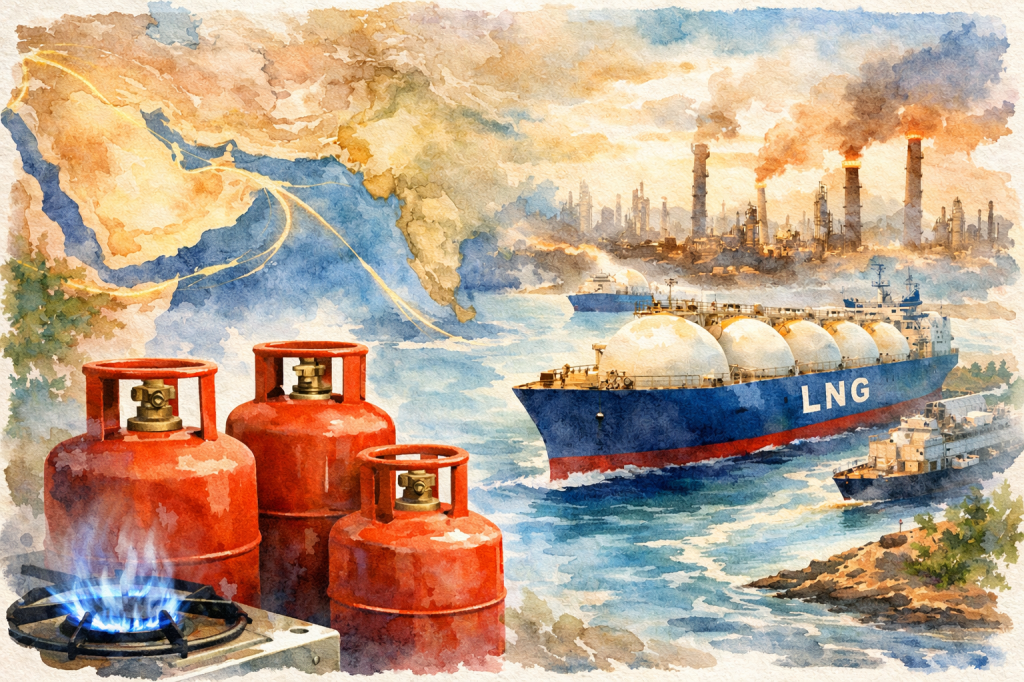
    Globalisation created the impression that energy flows freely across the world. The reality is more complex. Oil, LNG and LPG move through narrow maritime arteries, constrained by geography, protected by navies, insured by global financial markets and dependent upon political stability. The modern energy economy resembles less a reservoir and more a circulatory system. When arteries narrow, pressure rises everywhere — and it reaches ordinary households, long before the television anchors begin to explain why.

    The world is not as flat as we would like it to be !

    a) Hormuz: When the Valve Tightens — and the Insurer Leaves the Room

    While much public attention during crises focuses on oil and gas production, the immediate disruptions are often logistical — and, increasingly, financial. The events of early 2026 around the Strait of Hormuz offered a remarkably instructive lesson in how modern energy vulnerability actually works.

    Within forty eight hours of the intensification of conflict in the Gulf in February 2026, war risk insurance premiums surged fivefold. Major marine insurers terminated existing coverage. Lloyd’s Joint War Committee — a body that quietly governs the risk architecture of global shipping — redesignated the entire Arabian Gulf as a conflict zone. Tanker traffic collapsed by more than 80 percent. Not because the Strait was physically blocked. Because it had become commercially uninsurable.

    This is the insurance weapon — and it operates faster than any navy. In normal times, war risk insurance for a large crude tanker worth $100 million costs roughly $150,000 to $225,000 per voyage. By March 2026, premiums had surged to between 1% and 7.5% of vessel value — translating to between $1 million and $9 million per single voyage. For a ship operator running thin margins, this is not a cost adjustment. It is a commercial death sentence.

    The physical consequences follow swiftly. If Hormuz is threatened or partially disrupted, tankers face delays of 7–15 days or more. Freight rates spike. Spot cargo markets tighten. The effects extend far beyond hydrocarbons. India’s imports of petrochemicals, plastics feedstock, fertilisers and industrial chemicals face shortages or cost escalation. Gulf ports slow the movement not only of fuel but of consumer goods, machinery, electronics and food. Hormuz is therefore not merely an oil corridor. It is a strategic valve for inflation stability, industrial supply chains and household welfare simultaneously.

    If the Persian Gulf is the reservoir, Hormuz is the tap. And the insurance market is the hand that now sits upon it.

    b) Futures, Benchmarks and the Price Before the Price

    Before oil or gas arrives at an Indian import terminal, its price has already been determined — not at the wellhead, not even at the port, but in the global futures markets.

    Three benchmarks govern the world’s LNG price universe. Henry Hub, traded in the United States, sets the price of American natural gas. The Title Transfer Facility, known as TTF, does the same for Europe. The Japan-Korea Marker, or JKM, is the Asian equivalent — the number that India watches most closely.

    These are not merely price indicators. They are the pulse points of the global energy body. Just as a cardiologist reads the pressure differentials to understand where blood is flowing and where it is not, energy traders read the spread between these three benchmarks to decide where gas will move next. When the Asian pulse beats stronger than the American one — when JKM prices run well above Henry Hub — gas flows eastward. When that differential narrows, the flow redirects. Cargoes that might have reached India quietly pivot toward Europe instead, and Asia finds itself competing harder for supply.

    India sits at the receiving end of this calculus. The country’s state-owned importers have historically preferred long-term contracts over active financial hedging, which offers stability in normal times but leaves India more exposed when global price signals shift rapidly.

    Markets complicate an already complicated geography !

    c) The Gulf Dependency Paradox: Why Diversification Exists on Paper

    India has gradually diversified its energy suppliers. LNG and LPG cargoes increasingly arrive from the United States, Australia and other producers beyond West Asia. GAIL holds long-term contracts for 5.8 million tonnes of LNG annually from US terminals. India’s LNG imports from the US stood at $2.46 billion in 2024-25, a 74 percent increase from the year prior, making it the second-largest LNG supplier. Yet geography continues to exert its own stubborn logic.

    A voyage from the US Gulf Coast to India can take up to 45 days, compared with less than a week from the Gulf. This is not merely a matter of time — it is a financial multiplier. LNG carriers are among the most expensive commercial vessels in the world. A modern cryogenic tanker capable of maintaining temperatures below minus 160 degrees Celsius can cost well over $200 million to construct and typically commands charter rates of tens of thousands of dollars per day. Every additional day at sea increases financing, insurance and opportunity costs.

    A voyage lasting forty days therefore ties up a vessel several times longer than an equivalent Gulf route. Freight costs for US-origin LNG and LPG delivered to India are consequently often two or more times higher than comparable Gulf cargoes.

    The LPG market illustrates this particularly well. During periods of disruption, freight rates on routes from the US Gulf Coast to Asia can rise dramatically as buyers seek alternative supplies and vessels become scarce. Longer routes, congestion at strategic waterways and occasional rerouting around the Cape of Good Hope further increase costs. Geography, once again, reasserts itself. A molecule of gas may be identical whether it originates in Texas or Qatar, but the economics of moving it are profoundly different.

    The valve seems irreplaceable for now !

    d) Suez and the Red Sea: The Cost of Distance

    Unlike Hormuz, where vulnerability is immediate and concentrated, disruptions in the Suez-Red Sea corridor operate more subtly — through time, distance and cost.

    The strategic value of the Suez Canal lies in its role as the shortest maritime route between the Atlantic and Indian Ocean systems. Any disruption in the Red Sea-Suez corridor may force vessels to reroute around the Cape of Good Hope, adding roughly 3,500–5,000 nautical miles and approximately 10–14 days of transit time. The detour substantially increases fuel consumption, vessel utilisation costs, freight rates and insurance premiums. During recent Red Sea disruptions, shipping analysts estimated that a single Gulf-to-Europe voyage could incur several hundred thousand dollars to over a million dollars in additional fuel costs alone, even before war-risk surcharges were taken into account.

    Recent instability around Bab-el-Mandeb demonstrated that even if the Suez Canal itself remains operational, insecurity in adjoining waters can reduce vessel traffic significantly. For India, the Suez route remains critical for trade with Europe, westbound exports, and alternative supply lines for US and Atlantic Basin LNG cargoes. Suez disruptions rarely stop trade entirely — they make trade slower, costlier, and less predictable.

    One may even salute Monsieur Lesseps for his foresight to build the Suez !

    e) Panama and Malacca: Climatic and Great-Power Vulnerabilities

    The Panama Canal and the Strait of Malacca reveal that not all chokepoints are vulnerable in the same way — and not all threats wear war colours.

    The Panama Canal depends heavily on freshwater from surrounding lakes to operate its complex lock system. Drought conditions linked to El Niño have periodically forced restrictions on vessel transits and cargo loads — a reminder that in an era of climate change, geography itself can become less reliable. Since the American shale boom, the canal has become strategically important for LNG and LPG cargoes moving from the US Gulf Coast to Asia. A typical voyage from the US Gulf to Japan takes roughly 20–25 days via Panama, compared with more than 30 days via the Cape of Good Hope. During the recent drought-induced congestion, priority transit slot auctions reportedly reached approximately $1.76 million per vessel, illustrating how quickly a chokepoint can evolve from a passageway into a price-setter.

    Malacca presents a different challenge altogether. Stretching between Malaysia and Indonesia, it carries roughly one-quarter of global maritime trade and is central to the energy security of China, Japan and South Korea. The ‘Malacca Dilemma’ — China’s strategic anxiety about this bottleneck — has partly driven Beijing’s investment in alternative overland pipelines, ports and Belt and Road corridors. For India, Malacca represents the eastern gateway connecting the Indian Ocean to the Pacific trading system, which is why the Andaman and Nicobar Islands occupy such a pivotal position in India’s maritime calculus.

    f) How the Shock Reaches Ordinary People

    The consequences of geopolitical disruption eventually travel from distant seas into ordinary households — and the transmission mechanism is faster and more direct than most of us appreciate.

    A disruption at Hormuz increases war-risk insurance premiums, which are passed through to shipping costs, which are passed through to the landed cost of crude oil, LNG and LPG. Oil marketing companies face higher import bills. The LPG subsidy burden on the government rises. Cylinder prices come under pressure. Simultaneously, LNG price increases affect fertiliser production because natural gas is the primary feedstock for urea manufacturing. Rising fertiliser costs eventually reach food prices on every table.

    The result is not merely an energy issue, but an inflationary one. Energy geopolitics manifests itself in something as ordinary as the monthly household budget — a connection that is almost never articulated in the breathless television coverage of maritime conflicts.

    So non-core inflation becomes a core headache!

    g) India’s Strategic Vulnerability Hierarchy

    Not all fuels occupy the same strategic position in India’s energy architecture, and it is worth mapping the hierarchy clearly.

    Crude oil is macro-critical. Its disruption affects transport, inflation, foreign exchange reserves and the broader economy. India’s strategic petroleum reserves provide a limited buffer — but no equivalent strategic reserve exists for LNG or LPG.

    LPG is politically sensitive. With over 320 million household connections, its affordability is directly tied to welfare and social stability. A sustained price shock in LPG cylinders is felt more immediately and viscerally by India’s population than a comparable shock in any other energy category.

    LNG forms the industrial backbone. Fertiliser production, power generation and manufacturing depend upon it. A prolonged disruption does not merely raise prices — it can slow food production and industrial output in ways that compound over months.

    Together, these three fuels constitute the energy vulnerability architecture — and exposure to a single corridor, the Strait of Hormuz, cuts across all three simultaneously.

    h) Efficiency versus Resilience: The Trade-off Globalisation Made

    Modern energy systems frequently trade resilience for efficiency. The same globalisation that lowered costs also reduced buffers. As supply chains became leaner and faster, they simultaneously became more fragile. This is the central tension of our energy future: we may not be able to afford the cost of American LNG at scale, cannot build stockpiles overnight, and cannot decouple from the Gulf without paying a price — financial, logistical and strategic — that would dwarf any short-term political calculus.

    The modern world often imagines energy as something produced in distant deserts or offshore rigs. In reality, energy is sustained by a fragile choreography of geography, shipping lanes, ports, insurers, futures markets and political stability. From Hormuz to Malacca, from Suez to Panama, narrow waterways silently shape inflation, industrial output and household welfare across continents. And the insurance market, it turns out, can close a strait faster than any navy ever could.

    In the twenty-first century, the geopolitics of energy is no longer merely about who owns the resources — but about who controls, protects and sustains the arteries through which they flow, and who pays when they falter.

  • A Cauldron of Gases – Part 2: 
The Geopolitics of the Flame – The Chokepoints

    A Cauldron of Gases – Part 2: The Geopolitics of the Flame – The Chokepoints

    If Part 1 introduced the actors, in Part 2 we examine some of the major chokepoints through which they operate—an interconnected global system where geography determines the ebb and flow of energy and trade. In the modern world, narrow waterways often become strategic valves controlling commerce, industry and national power.

    In an ideal world, liquids and gases, unless restrained, flow freely. However, we do not live in a Utopia. So, in the real world, geography charts (and constrains) the flow of water on the Blue Planet. Some of the important pieces in this unique geographical jigsaw are:

    Strait of Hormuz: The Oil and Gas Valve

    (Map is not to scale and boundaries are only representative)

    The Hormuz Strait has been in the news lately due to the current West Asian imbroglio. This narrow maritime passage not only separates the Asian landmass from the Arabian Peninsula but also historically marked the interface between the Persian and Arabian worlds. A few theories have been put out with respect to its interesting etymology. Hormuz may have been derived from the Middle Persian pronunciation of the name of the Zoroastrian God Hormoz (Ahura Mazda). Alternatively, it may have been derived from the local Persian word Hur-Mogh ‘Place of Dates’. Another theory says that it was named after Ifra Hormizd, the mother of King Shapur II of Persia or after the Greek word for cove or bay.

    Around about 160km long, it is 40km wide at its narrowest, making inbound and outbound vessels follow a distinct course to avoid collisions and shallow waters. Around 20 million barrels of oil transits this narrow passage every day, representing around 20% of global petroleum consumption. Similar is the case for LNG. Around 80% of LNG bound for Asia transits Hormuz with Qatar dominating production. Specifically for India, 50-60% of LNG as well as LPG along with 30-35% of crude oil passes through this vital Strait which is a vital waterway (and a potential chokepoint) for fuel resources.

    Suez Canal Route: Moses Parted the Sea, Humans Parted the Land

    (Map is not to scale and boundaries are only representative)

    If the Strait of Hormuz is a natural chokepoint forged by geography, the Suez Canal is an artificial one engineered by human ambition. Strictly speaking, Suez is not a strait, as it is not a naturally occurring narrow water passage between two land masses. Rather, it is a man-made canal, linking the Mediterranean Sea at Port Said to the Red Sea at Suez, thereby connecting Europe directly with Asia. Long before the canal was established, sailors in search of spices and riches had to circumnavigate around the tip of Africa (called the Cape of Good Hope) to reach Asia.

    The canal derives its name from the Egyptian city of Suez, possibly originating from the ancient Egyptian term Suan meaning “beginning,” referring to its position at the head of the Red Sea. Other linguistic theories exist, though many remain speculative.

    The Suez Canal was a French project completed in 1869 under Ferdinand de Lesseps when colonial powers were searching for shorter routes to Asia. Its opening fundamentally altered maritime geography, shortening Europe-Asia voyages by nearly 7,000 kilometres and transforming Egypt into a geostrategic fulcrum of world trade. Sailing from Europe down the canal, one encounters another narrow constriction in the Red Sea between Yemen and Djibouti/Eritrea called the Bab-el-Mandeb, also known as the “Gateway of Tears”.

    Approximately 193 kilometres long, the canal traverses the Isthmus of Suez and today handles roughly 12-15% of global trade and 10-12% of global seaborne oil trade, according to multilateral shipping assessments. It is particularly critical for crude oil and refined petroleum products moving from the Gulf to Europe; LNG cargoes destined for European and Mediterranean markets; US and Atlantic Basin LPG/LNG shipments moving toward Asia and containerised trade between Europe and Asia.

    While not facing the same challenges as its cousin Hormuz, the waterway down the Red Sea at Bab-el-Mandeb has faced insurgency and piracy which have hampered trade and commerce from time to time.

    The Panama Canal: America Triumphs Geography and Europe

    (Map is not to scale and boundaries are only representative)

    The Suez project was designed, directed and produced by European imperialism. In the decades that followed, the United States, first through the Monroe Doctrine and subsequently through the Roosevelt Corollary, demarcated and enforced its sphere of influence.

    The Panama Canal became a physical manifestation of America’s transformation from a continental republic into a global geopolitical and maritime power.

    For centuries, imperial powers sought a shortcut between the two oceans. Erstwhile, ships which wanted to go from Europe and America to Asia had to sail around South America’s Cape Horn. The perilous journey of nearly 15,000 kilometres forced ships to endure the violent gales of the “Furious Forties” and “Screaming Sixties,” along with the hazardous waters around Cape Horn and the Magellan Strait.

    A French attempt led by Ferdinand de Lesseps collapsed amid engineering difficulties and tropical disease. The canal was eventually completed by the United States in 1914, using an elaborate and sophisticated system of locks and artificial lakes to lift ships across the continental divide.

    One widely recounted theory suggests that “Panama” originated from an indigenous word meaning “abundance of fish,” while another associates it with the “place of many butterflies.” The precise etymology, however, remains uncertain.

    Roughly 82 kilometres long, the canal today handles around 5–6% of global maritime trade and remains especially important for container trade, grain shipments and increasingly for US-origin LNG and LPG exports destined for Asia following the American shale boom.

    The Canal illustrates the fragility of engineered chokepoints. Unlike Hormuz or Bab-el-Mandeb, where the primary risks are geopolitical or military, Panama increasingly faces climatic and hydrological constraints. The canal depends heavily on freshwater from surrounding lakes to operate its lock system. Drought conditions linked to El Niño and changing rainfall patterns have periodically reduced water levels, forcing restrictions on ship transits and cargo loads. Such has been the canal’s strategic importance that Panama has historically witnessed repeated external political intervention. Today, the Canal faces threats, real and perceived, over its control by traditional and emerging economic superpowers.

    The Strait of Malacca: The Gateway to the East

    (Map is not to scale and boundaries are only representative)

    While Hormuz is the valve of Gulf energy and Suez and Panama are engineered bridges between continents, the Strait of Malacca is the crowded maritime funnel which breathes life into the economies of the East. Stretching between the Malay Peninsula and the Indonesian island of Sumatra, it links the Indian Ocean with the South China Sea and the wider Pacific.

    The Strait derives its name from the historic Sultanate and trading port of Malacca on the Malay coast, once among the wealthiest entrepôts of the spice trade. The word itself is believed to originate from the Arabic Malakat, meaning “congregation of merchants” or “meeting place of traders,” or from the Malay Melaka, associated with the Indian gooseberry tree under which, according to legend, a Sumatran prince rested while founding the settlement. Over centuries, the region drew Arabs, Gujaratis, Chinese, Portuguese, Dutch and British traders, making Malacca one of the earliest true crossroads of globalisation.

    Roughly 900 kilometres long, but narrowing to barely 2.8 kilometres at the Phillips Channel near Singapore, the Strait today carries around 25% of global maritime trade and is among the busiest shipping lanes in the world. More than 80,000 vessels transit it annually, transporting crude oil from the Gulf to East Asia; LNG cargoes toward China, Japan and South Korea; containerised trade between Asia, Europe and the Middle East and manufactured exports from East Asia to the world.

    For energy markets, its significance is immense. A substantial proportion of oil and LNG bound for East Asia—including shipments from the Gulf transiting Hormuz—passes through Malacca. It is therefore a critical artery for the energy security of China, Japan and South Korea.

    Strategically, the Strait occupies a central place in what has been called the “Malacca Dilemma”—the fear that hostile naval powers could disrupt China’s energy lifelines at this narrow maritime bottleneck. This vulnerability has partly driven Chinese investments in alternative overland pipelines, ports and the broader Belt and Road Initiative.

    Malacca faces its own unique set of challenges ranging from congestion and navigational hazards to sea piracy and naval competition. Any major disruption could force vessels to reroute through the longer Indonesian archipelagic passages, increasing voyage times, fuel consumption and freight costs substantially.

    For India, Malacca represents not merely a distant Southeast Asian waterway but the eastern gateway connecting the Indian Ocean to the Pacific trading system. Its strategic importance explains why the Andaman and Nicobar Islands occupy such a pivotal location in India’s maritime calculus.

    Together, these chokepoints reveal a fundamental truth of the modern world: energy does not merely flow through pipelines and tankers—it flows through geography itself. From Hormuz to Malacca, narrow waterways have become strategic valves controlling trade, industry and national power. In the next part, we examine what happens when these arteries are strained, disrupted or weaponised.