Part 1
Dramatist Personae – the Gases
Recent events in the Persian Gulf have brought to the fore discussions on energy and by extension, fuel and gases. Though they do not figure in the calculation of core inflation, their production and supply have worldwide ramifications. It is necessary to understand what these gases are, how are they produced and supplied and their uses.
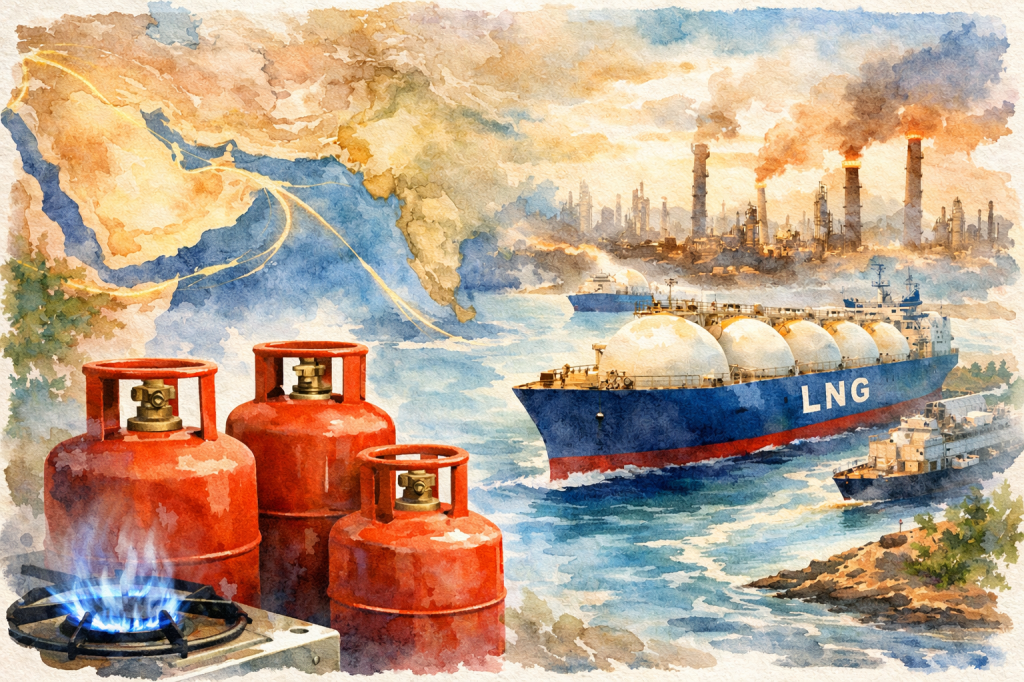
Let us first dissect three words going around. NG, LNG and LPG. Natural gas (NG) is basically methane, the stuff that contributes to the greenhouse effect and what many planets like Uranus and Neptune are engulfed with. Despite these major infirmities, it is critical as a fuel for cooking and transport, electricity generation and fertilizer production. Since it cannot be transported easily in gaseous state, it is cooled to -162 degrees into Liquified Natural Gas (LNG) which is supplied around the world in super tankers. The LNG is then converted back to gas at import terminals. In large city networks it is supplied to homes through pipes as Piped Natural Gas (PNG). For transportation it is used as Compressed Natural Gas (CNG).
Natural Gas is extracted from underground gas reservoirs or oil and gas basins. These are in the Middle East, Russia, North America (through shale extraction) and Australia. In India, natural gas is produced from offshore and onshore basins such as the Krishna–Godavari Basin, the Mumbai Offshore Basin and the Assam–Arakan Basin.
Natural gas consumption in India is currently around 195 million standard cubic metres per day (mmscmd). Roughly half of the demand is met through LNG imports with a large share coming from the Gulf region. Qatar alone accounts for about 39% of India’s LNG imports. Other major suppliers are Australia, United States, Russia and Oman.
Liquified Petroleum Gas (LPG) by contrast, is a different fuel composed mainly of propane and butane – higher cousins of Methane. It liquefies at moderate pressure and ambient temperature, which allows it to be stored easily in pressurised cylinders. This makes LPG particularly suitable for household cooking.
While LNG is largely used by industry and power plants, LPG is the primary cooking fuel for hundreds of millions of Indian households. India’s LPG consumption has grown sharply over the past decade with demand reaching about 31–33 million tonnes annually, driven by expanding household access. Domestic production remains limited at roughly 12–13 million tonnes per year, meaning the country imports around 20–21 million tonnes annually, equivalent to roughly 60–65% of total consumption. This makes India one of the world’s largest LPG importers.
The expansion in demand is closely linked to the rapid increase in LPG connections. The number of LPG consumers increased from about 145 million in 2014 to more than 320 million by late 2024, more than doubling within a decade. Much of this expansion occurred under the Pradhan Mantri Ujjwala Yojana, which sought to replace traditional biomass cooking fuels with cleaner alternatives. This has brought relief to millions of women who otherwise battled smoke and consequently ill health just to provide their families two square meals a day.
Unlike many European countries where households receive piped natural gas, India distributes LPG largely through cylinders delivered to homes through an extensive infrastructure present in rural and urban areas with bottling plants, storage depots and a robust network of distributors. The network of piped gas is expanding though they are expensive to lay, require dense urban infrastructure and significant capital investment.
LPG has two main sources. A significant portion is produced during crude oil refining, where propane and butane are separated from other petroleum products. LPG is also recovered during natural gas processing, when heavier hydrocarbons are extracted from raw natural gas streams before the methane is transported through pipelines or liquefied as LNG. As a result, LPG production is closely linked to both global oil refining activity and natural gas extraction.
India sources LPG from multiple producers, but the Middle East remains the dominant supplier. It is estimated that the region accounted for around 90% of India’s LPG imports. Supplies from the Gulf typically transit the Strait of Hormuz, one of the world’s most important energy shipping corridors. Disruptions affect shipping routes and freight costs. In recent years, diversification efforts have begun. India has begun expanding imports from other suppliers, including the United States, Norway and Canada.
India’s overall storage capacity remains limited compared with total consumption, reflecting the historically steady flow of imports from nearby Gulf producers and the logistics of distributing cylinders rapidly across the country.
India’s rising LPG demand has also reshaped global energy trade. Together with China—where LPG is used heavily in petrochemical manufacturing—India now accounts for a significant share of global LPG import growth. This has encouraged exporters, particularly the United States following its shale energy boom, to expand LPG shipments to Asia.
Despite occasional supply disruptions or geopolitical tensions, India’s LPG distribution system generally operates with multiple suppliers and diversified shipping routes. While short-term market fluctuations can affect prices or logistics, long-term demand growth reflects structural changes in household energy use and improved access to cleaner cooking fuels.
Understanding the distinction between natural gas and LPG is therefore essential to interpreting headlines about energy supply disruptions and their actual implications for Indian households.


 Curiously
Leave a reply to Kaiminlun Haokip Cancel reply